


Staffing agencies have to make payroll every week, but most clients take 30 to 90 days to pay their invoices. That cash flow gap can force agencies to decline business because they don’t have enough cash to meet payroll in the first few weeks before any client payment comes in.
When agencies run into this problem, most turn to bank loans. In practice, however, banks are one of the most difficult financing options to qualify for. They have extremely strict, borderline unrealistic criteria, requiring excellent credit, large profit margins, cash reserves, collateral, and more. As a result, only about 13% of businesses that apply for bank loans qualify.
Additionally, banks take around 60 to 90 days to approve and fund loans due to all the requirements and paperwork they have to underwrite.
To help you find a better fit, we wrote this guide comparing 10 popular financing options against the two factors above: ease of qualification and closing speed.
Throughout the article, we cover how Redline Capital can help staffing agencies secure affordable financing on the same day they apply and with just 4 months of bank statements.
Submit four months of bank statements and receive financing offers the same day. Our application takes less than five minutes and will not affect your credit score.
1. Revenue-Based Financing
Revenue-based financing is usually the best funding option for staffing agencies that need capital quickly and want to avoid the stringent qualification criteria of banks.
That is because approval is based entirely on your staffing firm’s monthly revenue. The only requirement you have to meet is the financing provider’s minimum monthly revenue threshold. With Redline Capital, that’s $30,000 per month.
This straightforward requirement makes revenue-based financing an accessible financing option for staffing agencies. You don’t need large profit margins, extensive cash reserves, hard assets, a clean record of judgments and liens, or any of the other things banks typically require.
At Redline Capital, we approve over 80% of the businesses that apply with us.
Read more: Why Use Revenue-Based Financing Instead of Debt Financing?
How to Apply for Revenue-Based Financing
The application process for revenue-based financing differs from lender to lender. However, at Redline Capital, our application takes less than five minutes.
- Submit four months of business bank statements and fill out a short application with basic information about your staffing business.
- We review your revenue and email you multiple financing offers within one to two hours. Each offer details the funding amount you qualify for, the rates and fees, the term length, and the payment frequency.
- Take as much time as you need to review the offers. We never pressure you into accepting as other lenders do. We encourage you to apply with and compare offers from other lenders before making a decision.
- Once you accept an offer, funds are wired into your business bank account within one or two hours. From start to finish, the whole process takes less than 24 hours. In urgent situations, we have funded staffing companies in under 4 hours.
Compare this to applying for a bank loan. You’ll need to spend days gathering tax returns, balance sheets, profit and loss statements, and other documentation, then wait 60 to 90 days for a decision.
Read more: How to Apply for Revenue-Based Financing
Types of Revenue-Based Financing for Staffing Agencies
There are four main types of revenue-based financing options for staffing agencies:
- Working capital loans are short-term financing used to cover payroll, rent, and other day-to-day operating expenses while you wait for client payments.
- Term loans are longer-term financing options with larger amounts that staffing agencies can use to expand into new markets, open new offices, or invest in technology and back-office infrastructure.
- Business lines of credit are flexible financing you can draw on as needed, similar to a credit card but typically with better terms. They are ideal for agencies with variable week-to-week payroll needs.
- Merchant cash advances are funding solutions that provide a lump-sum upfront in exchange for a percentage of future revenue, with repayment automatically deducted from daily or weekly bank deposits.
Regardless of what you call it, Redline Capital evaluates the same thing: your monthly revenue deposits.
Why Choose Redline Capital for Staffing Agency Financing
You Can Secure Lower Rates When You Apply with Us
Over the past decade, Redline Capital has built deep relationships with leading business lenders, including OnDeck, Rapid Finance, and Headway Capital, among others. We deliver hundreds of millions of dollars in loan volume their way each year, helping them scale their lending operations.
In return for all our business, they give our clients wholesale rates, preferred pricing, discounts, and larger loan amounts that would not be available through a direct application.
Applying through Redline Capital allows you to put our 10+ years of lender relationships to work for your business. You secure better terms than you could on your own, and if your application falls into a gray area, we can negotiate with lenders to push for an approval that might not otherwise happen.
We Have Extensive Experience with Staffing Agencies
We’ve spent years working with staffing agencies, so we understand how they actually operate. We understand that net 60- to 90-day payment terms, fluctuating revenue, and thin profit margins are normal in staffing, not signs of a struggling business. So, we won’t penalize you with higher rates or reject your application for this.
Lenders without staffing experience often misread these as red flags of your staffing company, failing to recognize them as standard industry characteristics.
We Never Pressure You to Accept an Offer
Many financing companies will bombard you with calls and emails the moment you submit an application. They use high-pressure tactics designed to rush you into a decision that doesn’t fit your business needs.
Some even claim the offer is about to expire or that advance rates are going up, all to push you into accepting terms that may not be right for your business.
At Redline Capital, we email you the offers you qualify for and give you all the time you need to review them. There are no countdown timers, no follow-up calls, and no obligation to accept. Take as long as you need to review the terms before making a decision.
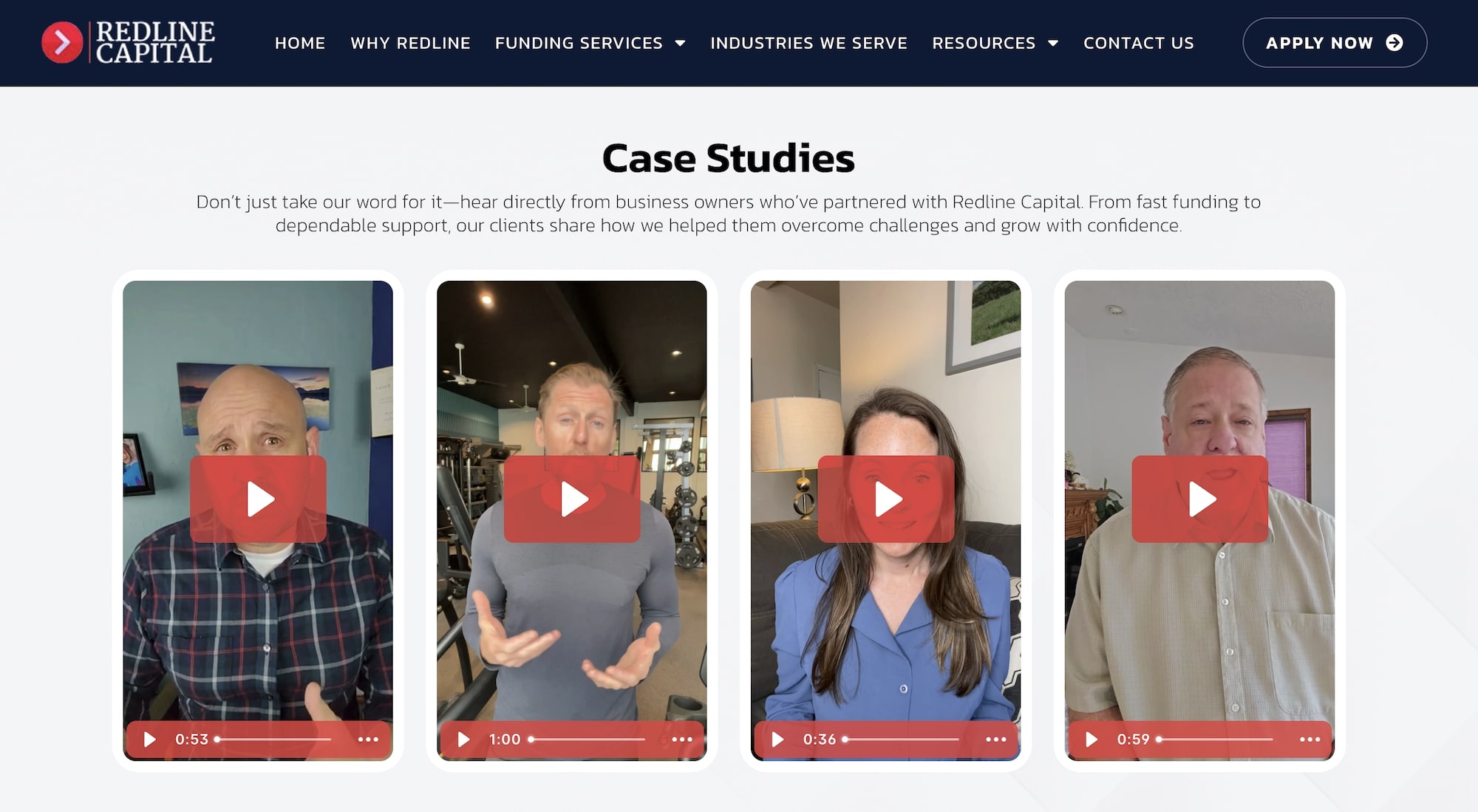
Here is what business owners say about working with Redline Capital:


For more client stories, visit our case studies page.
Secure Revenue-based Financing for Your Staffing Agency with Redline Capital
Submit four months of bank statements, and we’ll send you offers within one to two hours, most of which can close the same day.
2. Payroll Funding
Payroll funding is a financing solution built specifically for the staffing industry’s cash flow cycle. A payroll funding company advances you cash against your outstanding client invoices so you can meet weekly payroll without waiting 30 to 90 days for clients to pay.
The process works like this: you place workers, submit timesheets and invoices to the payroll funding company; they advance you 80% to 90% of the invoice value; you make payroll on time; and when your client pays, the funding company releases the remaining balance minus a fee.
Payroll funding is purpose-built for staffing and is faster to set up than a bank loan, with initial funding typically taking three to five days. The key limitation is that approval depends heavily on your clients’ creditworthiness rather than yours. So, if your clients are smaller businesses or do not have strong credit profiles, qualification can be hit or miss and largely outside your control.
3. Invoice Factoring
Invoice factoring works similarly to payroll funding but is not exclusive to the staffing industry. A factoring company purchases your outstanding invoices at a discount, advances you 70% to 90% of their value, and collects payment directly from your clients.
The main advantage over bank loans is speed and easier qualification. Approval is based on your clients’ creditworthiness rather than yours, and initial funding typically takes three to five days after setup. The downside is that the factoring company contacts your clients directly to collect payment, which can strain client relationships if they use aggressive collection practices.
Factoring fees typically range from 1% to 5% of the invoice value per month. Like payroll funding, qualifying depends on your clients’ credit history, making it an unreliable option for agencies whose clients are smaller, newer, or have less-than-perfect payment histories.
4. Traditional Bank Loans
Traditional bank loans offer the lowest interest rates, typically 6% to 15%, but come with the most demanding qualification criteria. You will need excellent credit (usually 720 or higher), multiple years of tax returns, profit and loss statements, balance sheets, and often collateral or personal guarantees, in order to qualify.
As a result, it’s not uncommon for the approval process to take 60 to 90 days. This effectively rules out bank loans for agencies facing urgent payroll obligations.
On top of that, banks rarely lend amounts that reflect your actual revenue potential, typically capping loans at 50% of monthly revenue or less. If your agency generates $100,000 per month, a bank might approve you for $50,000 at most.
Bank loans work best for established agencies with strong credit, complete financial records, and months to wait for approval.
5. SBA Loans
SBA loans are government-backed loans that offer favorable terms. They offer lower interest rates than conventional bank loans, repayment periods of up to 25 years, and reduced collateral requirements. The SBA does not lend money directly, however; it guarantees a portion of the loan, making banks more willing to extend credit to startups and small businesses.
The tradeoff is time and complexity. SBA loans require a detailed business plan, financial projections, tax returns, and personal financial statements. As a result, the approval process takes 60 to 90 days or longer.
These loans make the most sense for agencies that need larger amounts of capital, typically $1 million to $5 million, have time to navigate the application process, and meet the SBA’s eligibility requirements.
6. Business Lines of Credit
Business credit lines give you revolving access to a set credit limit that you can draw from depending on your cash flow needs and repay over time. Interest accrues only on what you draw, not the full limit, making it a flexible option for managing variable week-to-week payroll needs.
Banks offer lines of credit at 6% to 15% interest but require strong credit and full financial documentation. Alternative lenders offer lines with fewer documentation requirements but at higher rates, typically 15% to 40%.
Redline Capital offers business lines of credit through our revenue-based financing program. You only need four months of bank statements to qualify, and you can access funds the same day.
7. Merchant Cash Advances
Merchant cash advances provide a lump sum upfront in exchange for a percentage of your future revenue.
The main advantage of MCAs is that they are fast. Most MCA providers can approve and fund your advance in 3 to 5 days.
Additionally, MCA providers review your recent revenue rather than credit scores or detailed financial statements, making it easier to qualify for than bank loans.
However, the tradeoff is cost. MCAs use factor rates typically ranging from 1.18 to 1.49, meaning a $100,000 advance may require repaying $118,000 to $149,000.
MCAs work best for agencies with consistent revenue that need capital quickly and do not qualify for lower-cost options. They are not ideal for long-term financing needs due to their higher cost of capital.
Read more: 10 Merchant Cash Advance Alternatives & How to Choose
8. Asset-Based Lending
Asset-based lending allows you to borrow against your business assets, accounts receivable, equipment, or real estate. The lender advances a percentage of the asset value, typically 70% to 90% for receivables.
This can provide access to larger amounts of capital than unsecured financing, but comes with ongoing reporting requirements and periodic audits. Interest rates typically range from 8% to 20%, depending on asset quality and business risk.
Asset-based lending works best for larger, established agencies with substantial receivables who need capital beyond what unsecured financing can provide. The reporting requirements and audit obligations make it less practical for smaller agencies.
9. Peer-to-Peer Lending
Peer-to-peer lending platforms connect businesses with individual investors willing to lend money. Platforms like Funding Circle facilitate these transactions, handling underwriting and loan servicing.
Interest rates typically fall between traditional bank loans and alternative lenders, usually 10% to 30%, with faster approval processes and less stringent documentation requirements than banks. Loan amounts are generally smaller, typically ranging from $25,000 to $500,000.
Peer-to-peer lending works well for agencies that do not qualify for traditional bank loans but want better rates than most alternative lenders offer. It is not a solution for urgent payroll needs, given the typical approval timeline of several days to a week.
10. Microloans
Microloans are small business loans, typically under $50,000, offered by non-profit organizations and community lenders. They are designed to help startups and smaller businesses access capital when traditional banks will not lend.
Like bank loans, microloans require business plans, financial statements, and often personal guarantees. The approval process takes weeks or months, and most microlenders have strict credit requirements.
Microloans work best for early-stage agencies with modest capital needs and time to navigate the application process. If you need funds within days to cover payroll, microloans will not solve the problem quickly enough.
Get Same Day Financing for Your Staffing Agency with Redline Capital
Send us a four-month bank statement and receive financing offers the same day. Our application takes less than five minutes and will not affect your credit score.