


Merchant cash advances (MCA) are among the fastest types of funding options, typically funding in 3 to 5 days; however, they are also extremely expensive. Factor rates often range from 1.3 to 1.5, which can translate to APRs over 50% when annualized.
To help business owners secure fast financing at more reasonable rates, we cover the 10 best merchant cash advance alternatives.
Ready to explore more affordable financing options? Submit four months of bank statements and we’ll send you multiple competitive offers that can fund as early as today or tomorrow.
1. Revenue-Based Financing
As the name implies, revenue-based financing is approved primarily on your business’s monthly revenue rather than your credit score, cash reserves, collateral, debt-to-income ratio, or profit margins. This offers three advantages over most forms of financing:
- Easier qualification: Since approval is based on your revenue, you simply need to meet the monthly revenue requirement to qualify. At Redline Capital, our monthly revenue requirement is $30,000. You don’t have to meet criteria around your business’s profit margins, cash reserves, or debt-to-income ratio.
- Fast funding: The only paperwork you need is a few months of bank statements showing you meet the revenue threshold. Less paperwork means faster approval and funding. For example, Redline Capital only asks for a 4-month bank statement, and our clients regularly close on the same day they apply.
- Lower interest rates and fees: Because revenue-based financing doesn’t evaluate (or penalize) businesses based on bad credit, no collateral, high debt-to-income ratios, or low cash reserves, you can qualify for lower rates than most alternative financing products.
How to Apply for Revenue-based Financing & What Paperwork to Prepare
Our application process is designed to be as fast and straightforward as possible:
- Send us a 4-month bank statement and complete a short application that asks for basic information about your business, such as your monthly revenue, desired loan amount, and industry. No tax returns, profit and loss statements, or other financial documents required.
- We evaluate your application and business bank statements, run a soft credit check, and email you multiple revenue-based financing offers you’re approved for. Each offer details the loan amount, factor rate, and repayment terms.
- Select the offer that best fits your business needs. At this stage, we recommend shopping around and comparing offers, and you’re welcome to go with another lender if they offer better rates and terms. That said, in our experience, borrowers most often choose us because of the quality of our offers.
- Immediately after you accept, you receive the funds in your bank account via wire transfer or ACH deposit.
Types of Revenue-Based Financing Products
The three main types of revenue-based financing products include:
- Working capital loans: Short-term, lump sum financing ranging from 6 to 24 months, perfect for covering immediate expenses like payroll, rent, inventory, or marketing campaigns while waiting for accounts receivable.
- Term Loans: Larger loan amounts up to $2 million with longer repayment schedules, typically 1 to 3 years. These are ideal for significant business investments, equipment purchases, or expansion projects.
- Business Lines of Credit: Revolving credit that works like a business credit card. You can access a set amount of funds, repay only what you use, and as you pay down the balance, your credit is replenished automatically. No reapplication required.
What Sets Redline Apart From Other Providers on the Market
Redline Capital is a revenue-based financing provider that helps businesses across a variety of industries secure affordable, same-day financing, including:
- Restaurants
- Contractors and construction companies
- Doctors, dentists, and other healthcare professionals
- E-commerce and retail stores
- Manufacturing businesses
- Professional services such as legal firms, consultants, and marketing agencies
- Spas and salons
- Gyms
- Daycares
Here’s what sets us apart from other business financing providers.
We Help You Secure the Lowest Possible Rates for Your Business
Many businesses assume applying directly to a lender guarantees better rates. But high-quality brokers like Redline Capital can help you secure exclusive rates and terms through our relationships with premium business lenders.
We’ve generated hundreds of millions of dollars in loan applications for OnDeck, Rapid Finance, Headway Capital, and other lenders over the past decade. In return for this consistent business, these lenders offer our applications preferred pricing, wholesale rates, and discounts that aren’t available when you apply directly.
When you apply through Redline Capital, you’re drawing on all the business we’ve sent to our lending partners to secure better terms for your business.
Additionally, we can leverage competing offers to negotiate with lenders, often securing rates even lower than their initial proposals. If one lender provides a strong offer, we can present it to others and ask if they can beat it, something individual borrowers rarely have the leverage to do.
We Carry Ourselves with Professionalism
One of the biggest problems in the alternative lending space is aggressive, high-pressure sales tactics. Many merchant cash advance providers will bombard you with calls and emails, pressuring you to accept expensive offers before they apparently “expire.”
At Redline Capital, we take a completely different approach. We present you with multiple business financing options and give you the time and space to make the decision that’s right for your business. We never pressure business owners to accept offers, and you’re free to choose a different lender if you prefer.
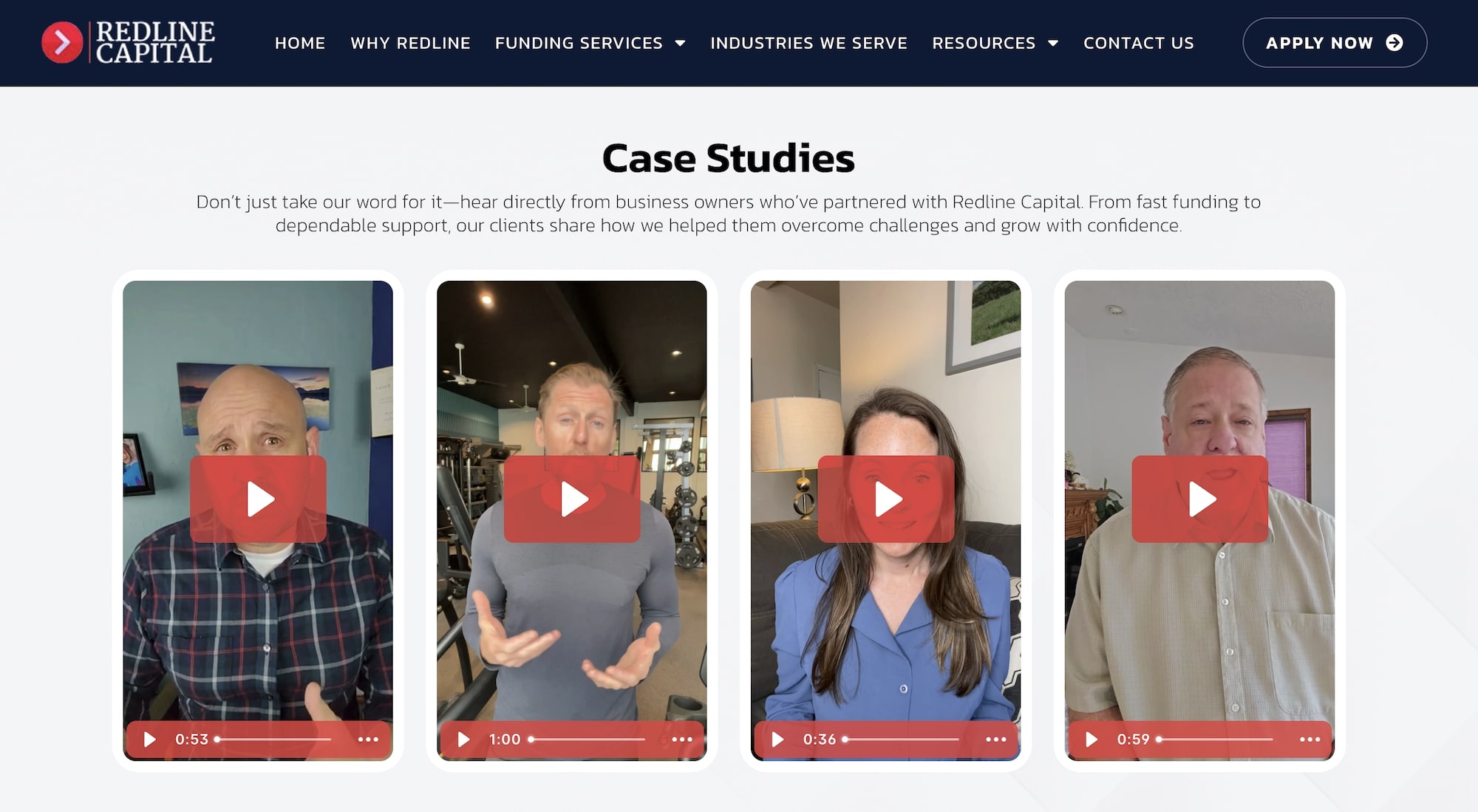
Here’s what businesses say about working with Redline Capital:


Visit our case studies page to watch video testimonials of clients talking about their experience working with us.
Submit 4 months of bank statements and we’ll email you multiple revenue-based financing offers that can fund as quickly as today or tomorrow.
2. Invoice Factoring
Invoice factoring is a funding solution that involves selling your unpaid invoices to a third-party company for immediate cash. You’ll typically receive 70% to 90% of the invoice value upfront, with the factoring company collecting outstanding invoices directly from your customers.
Instead of waiting 30, 60, or 90 days for customers to pay, you get quick cash, typically within a couple of business days. Once your customer pays the factoring company, you receive the remaining balance minus the factoring fee.
Invoice financing can be a lifesaver if you’re a B2B company with reliable customers facing cash flow gaps. The approval is based on your customers’ ability to pay, not your credit history, business growth, or profit margins. Since you’re selling an asset rather than borrowing money, it doesn’t add debt to your balance sheet.
That said, you lose control over customer collections, which can create awkward situations. Fees typically range from 1% to 5% per invoice, and if you factor regularly, those costs add up fast. Your customers will know a third party is collecting on your invoices, which some view negatively. And if you’re a retail business or get paid at the point of sale, factoring simply won’t work for you.
3. Traditional Bank Loans
Banks offer the lowest interest rates you’ll find, but only if you qualify.
Banks typically want to see excellent credit (720+), as well as extensive financial documentation, including profit and loss statements, tax returns, and balance sheets. They often require collateral and personal guarantees. The approval process usually takes 60 to 90 days, and the average approval rate for small business bank loans sits at just 13%.
When traditional loans make sense: If you have strong financials, excellent credit, and can wait months for approval, bank loans offer the best long-term rates. They’re ideal for established businesses with predictable cash flow and time to spare.
When they don’t: Most small businesses that need money fast simply don’t qualify or can’t wait. If you need to make payroll today or you need funds for urgent equipment repairs, banks aren’t going to solve your immediate problem.
4. SBA Loans
Small Business Administration loans are partially guaranteed by the government, which lets banks offer lower interest rates and more flexible repayment plans than conventional loans. Rates typically range from 6% to 13%, making them attractive for qualifying businesses.
But here’s the catch — SBA loans require even more paperwork than traditional bank loans and often take 60 to 90 days to process. Small business owners must meet strict eligibility requirements and provide extensive documentation of their business operations, financial history, and intended use of funds.
These long waiting times also mean that if the bank finds a problem with your application 60 or 90 days into underwriting, it can lead to frustrating last-minute rejections.
Overall, SBA loans can be excellent if you’re planning ahead and have time to navigate the bureaucracy. But if you need to bridge cash flow gaps or pay for urgent expenses, they aren’t the best option.
5. Asset-Backed or Hard Money Loans
These loans use your business assets as collateral. These typically include real estate, equipment, inventory, or bank accounts. Because the lender can seize your assets if you default, they typically offer lower interest rates than unsecured financing.
The business funding process requires appraisals and extensive documentation about your collateral, which can take weeks. You’re also putting essential business assets at risk. If you can’t repay the loan, you could lose the equipment or property you need to operate.
We recommend choosing asset-backed loans when you have valuable assets, need lower rates than unsecured options, and can handle the risk of potentially losing collateral.
6. Equipment Loans
Equipment financing lets you purchase machinery, vehicles, or technology using the equipment itself as collateral. Since the equipment secures the loan, lenders typically offer competitive rates and terms up to 7 years.
The equipment loan process involves appraisals, vendor quotes, and documentation that can take several weeks to complete. You’re also limited to using the funds specifically for equipment purchases.
Equipment financing typically works if you need specific equipment and have time for the approval process.
7. Business Credit Cards and Lines of Credit
Business credit cards provide flexible access to funds without reapplying each time you need capital. Unlike regular lump sum loans, you don’t pay interest on the entire loan amount, only on the amount you withdraw.
At Redline Capital, we offer lines of credit up to $750,000 that can close within 24 to 48 hours. This makes them a practical alternative when you need quick access to capital but don’t want to take a full term loan upfront.
The advantage of business credit cards and lines of credit is that you have ongoing access to funds as your business operates, rather than getting a lump sum and then having to reapply later.
However, credit limits may be too small for major business expenses, and carrying balances can result in high interest costs. They are mainly for smaller, ongoing business expenses like inventory purchases, marketing costs, or equipment repairs.
8. Crowdfunding
Crowdfunding involves raising money from many people through online platforms like Kickstarter, Indiegogo, or equity crowdfunding sites.
For donation-based campaigns, you don’t need to repay the money or meet traditional qualification criteria. However, success isn’t guaranteed and requires significant marketing effort to build momentum. Campaigns typically run 30 to 60 days, making crowdfunding unsuitable for immediate business funding needs.
Crowdfunding makes sense for consumer products, creative projects, or businesses that can generate public interest. But it doesn’t usually work for immediate cash flow problems or traditional business operations that don’t capture public imagination.
9. Business Grants
Grants provide funding that doesn’t need to be repaid, making them attractive when available. However, grants are highly competitive, have specific use requirements, and often take months to secure.
Most grants target specific industries, demographics, or business purposes. The application process typically involves detailed proposals, financial projections, and extensive documentation about how you’ll use the funds.
Grants work best as part of a long-term funding strategy for businesses that meet specific criteria. They aren’t a practical option for immediate cash flow needs or general business expenses.
10. Investors
Bringing in angel investors, venture capital, or private equity can provide significant capital without debt obligations. However, you’ll give up equity and (potentially) control in your business.
The investor process typically takes months and requires extensive due diligence, financial analysis, and legal documentation. Investors also expect significant growth potential and may want input on business decisions.
Businesses typically consider investors when they’re seeking substantial capital for expansion, have high growth potential, and are comfortable giving up some control. However, they typically aren’t a solution for immediate cash flow problems or businesses that need quick capital to maintain operations.