


As the name suggests, dental practice loans are designed to help you start, acquire, or expand a dental practice, covering expenses such as equipment purchases and repairs, working capital, rent, marketing, and renovations.
However, a major problem in dental financing that few people talk about is how common last-minute complications and rejections are. Borrowers often spend 60 to 90 days waiting for approval, only to be declined late in the process, forcing them to restart with a new lender.
To secure fast dental practice financing and avoid last-minute rejections, consider the following factors in a lender:
- What are the eligibility requirements? This is a good way to gauge the likelihood of last-minute rejections. Stricter requirements mean the lender spends more time evaluating and underwriting your dental practice, increasing the risk of issues being discovered later. Pick a lender with reasonable qualification criteria, so you know if you qualify immediately after submitting your documents.
- What paperwork is required? A reliable way to gauge a lender’s closing speed is to look at their paperwork requirements. If a lender asks for mountains of documents, such as balance sheets, profit and loss statements, and accounts receivable reports, then it’s unlikely that you’ll close quickly. Choose a lender that requires minimal paperwork.
In this article, we explore the two factors mentioned above in greater detail so you can secure a dental practice loan quickly, without last-minute drama.
We’ll then show you how to evaluate lender offers so you can tell the difference between strong deals and those best avoided.
Redline Capital is a revenue-based financing company that has funded dental practices for over 10 years. To apply, submit a 4-month bank statement, and we can fund on the same day, sometimes in just 4 hours.
Factor #1: What Are the Requirements to Get a Dental Practice Loan?
You can get a business loan for your dental practice from two types of financing providers: traditional banks and revenue-based financing companies. The requirements for each one vary greatly.
To get a loan from a traditional bank, your dental practice needs to be in near-perfect condition. You’ll need substantial cash reserves, large profit margins, a strong credit score, collateral, and more. Due to these strict requirements, only 13.8% of small businesses get approved. So, as a dental practice, you’re unlikely to qualify for traditional bank loans.
However, the bigger problem here is that underwriting all these requirements takes months. If banks find problems with your application late into underwriting, you may receive a rejection letter right before you’re supposed to get funded.
As an alternative, we recommend applying with a revenue-based financing provider like Redline Capital, which has extensive experience in the dental industry.
Instead of asking your practice to be in perfect condition, revenue-based financing providers primarily focus on your revenue. This makes it much easier to qualify for a dental practice loan. For example, with Redline Capital, you just need to meet the following criteria:
- $30,000 in monthly revenue
- 12 months in operation
- A U.S location
These simple requirements speed up underwriting, allowing us to get back to you with a yes or no within a few hours (no last-minute rejections) and for you to receive your funds on the same day.
Additionally, because we look at your revenue rather than your credit, cash reserves, or collateral, we can extend financing up to 200% of your monthly revenue, while banks usually limit funding to 50%.
Factor #2: What Paperwork Does the Lender Require?
A good way to estimate how quickly a lender can close is to check how many documents they require. More documents typically mean you’ll have to wait longer to close, because the lender must review and underwrite all that paperwork.
Applying for a dental practice loan at a bank means you need to gather and submit endless paperwork, including two years of balance sheets, profit and loss statements, credit card statements, proof of collateral, proof of cash reserves, and tax returns.
Once you submit these documents, the bank sends them for underwriting, which takes between 60 and 90 days.
This process is far from ideal for dental practice owners, especially when they need money to cover immediate expenses such as staffing, equipment maintenance and repairs, and supplier payments.
At Redline Capital, we offer fast funding because the only paperwork we need is 4 months of bank statements confirming you meet the minimum $30,000 monthly revenue threshold. Here’s what the application process looks like:
- Submit four months of bank statements and complete our short application form. The form asks for the type of financing you need, the amount requested, your monthly revenue, and how long you’ve been in business.
- We send your application to our underwriters, who’ll review your monthly recurring revenue and run a soft credit check to help calculate the amount you qualify for. This doesn’t affect your credit score.
- Within a few hours, we email you multiple offers for revenue-based term loans, working capital loans, business lines of credit, and equipment financing. We can get back to you with offers quickly because we mainly underwrite revenue, not all the other factors banks consider.
- Once you’ve selected an offer, just email us. You’ll receive the funds immediately via wire transfer or ACH.
If your initial application isn’t approved, we still present you with alternative financing options that you do qualify for. This is not something traditional banks offer. If you don’t qualify for a loan, they simply send you a rejection email. They don’t give you any further direction, which means you have to start the loan process all over again with a different bank, possibly without knowing exactly why your application was rejected.
Common Types of Loans for Dental Practices
The most common dental practice loans include:
- Working capital loans provide dentists and other healthcare professionals with funds to manage day-to-day operations, cover unexpected expenses, and maintain cash flow while waiting for insurance payments. These short-term loans are essential for covering operational costs and ensuring the practice runs smoothly.
- Equipment loans help dentists acquire the equipment they need for their practice, including X-ray machines, scanners, and dental chairs. These loans allow for the purchase or refinance of dental equipment, spreading the cost over time to manage cash flow. At Redline Capital, we offer up to 100% financing — no personal guarantees or down payments required.
- Dental practice acquisition loans provide funds to purchase an existing dental practice, including assets such as patient records and equipment, or to acquire a new practice location through a buy-in or transition. Some lenders may finance up to 100% of the purchase price, making these loans a common option for dentists moving from associate roles into practice ownership without a significant down payment.
- Term loans are longer-term business loans that can be used for a variety of business needs, including purchasing equipment, expanding the practice, or buying out a partner. Term loans typically range from 2 to 10 years and are much larger in size than working capital loans.
- Lines of credit allow you to withdraw the amount you need and only pay interest on the withdrawn amount, not the entire credit limit. As you repay the loan, you can use it again. One approval can essentially give you access to multiple rounds of financing. This can be used to cover operational costs, such as payroll, supplies, and equipment, especially when there are gaps between insurance payments and expenses.
- Small Business Administration (SBA) loans are backed by the government and designed to help small business owners. They offer lower down payments and longer repayment terms than traditional bank loans, making them a great loan option for dental practices that may struggle to qualify for conventional loans. However, the application process can be time-consuming, with additional paperwork required.
How to Evaluate a Dental Practice Loan Offer
When evaluating an offer, you are the best person to decide what is suitable for your dental practice. However, here are some pointers to help you make an informed decision:
Which Lender Offers the Lowest Loan Rates?
The most important factor to consider in a loan offer is the loan amount versus the total amount you need to repay.
To secure the lowest rates, many businesses are hesitant about brokers because they want to avoid unnecessary fees and go straight to the source of their funds. Though there’s some truth in that, a high-quality broker should be able to help you secure better rates than if you applied directly.
That’s because high-quality brokers like Redline Capital have built strong relationships with premium business lenders over the last decade, including Credibly, OnDeck, and Rapid Finance. We regularly send them high-quality loan applications, and in return, they offer our applicants preferential pricing, exclusive discounts, larger limits, and wholesale rates that aren’t available to one-off applicants.
Additionally, our lending partners are happy to negotiate with us. If one of our applicants requires a higher amount, more flexible repayment options, or a lower rate than what the lender would usually offer, we can negotiate these conditions on their behalf. It’s uncommon for lenders to negotiate with individual applicants.
How Long Do You Have to Repay the Loan?
Another factor to consider is how long you have to repay the loan. We recommend opting for loans with longer terms, as they give you more time to repay and break the balance into smaller, more manageable monthly installments.
At Redline Capital, we help our clients secure longer-term dentistry loans than they’d typically receive when applying directly to a lender, thanks to the strong relationships we’ve built with our lending partners over the years.
We also offer more flexible repayment terms. For example, we can set it up so that you don’t have to make loan payments for the first 3 months. Or, we can adjust monthly payments to align with your seasonality. Lenders don’t offer direct applicants this kind of flexibility.
How Quickly Can the Lender Fund Your Loan?
If you need funds to cover urgent expenses, consider how long it takes to close.
When you apply with Redline Capital, we send you multiple offers that you qualify for within a few hours after your application. Once you accept an offer, you receive the funds on the same day or the next.
This does not happen with traditional banks, credit unions, and other large financial institutions. With these lenders, it usually takes 60 to 90 days to get your funds because of all the paperwork they must underwrite.
Do You Need Collateral?
Consider whether the lender asks you to provide collateral. This is very common among banks and larger lenders, but we recommend avoiding any offers that require collateral.
This is because if you cannot repay the loan, the lender can seize and liquidate the collateral, which can include new equipment, cash reserves, business checking accounts, or commercial real estate needed to run your business.
Instead, consider unsecured business financing, which doesn’t need collateral. With Redline Capital, all our offers are unsecured.
How Reputable Is the Lender?
One last factor to consider is the lender’s reputation.
Subprime lenders are more likely to offer you expensive, short-term financing deals and aggressively pressure you to accept them, knowing that it’s not the best option for your business.
To avoid this, look for financing providers with excellent online reviews and a proven track record of professionalism. For instance, with Redline Capital, our team doesn’t put any pressure on you to accept any offer. When you apply, we’ll send you multiple offers you qualify for, answer any questions, and then leave it up to you to decide. You are in complete control of whether to move forward.
In addition, we genuinely care about our clients. So if your business doesn’t qualify for the financing product you applied for, we will send you offers for other products that are easier to qualify for, such as small business loans, working capital loans, short-term merchant cash advances, equipment financing, and SBA 7 loans. This is typically not something traditional banks do.
Here’s what our clients say about our application and closing process:


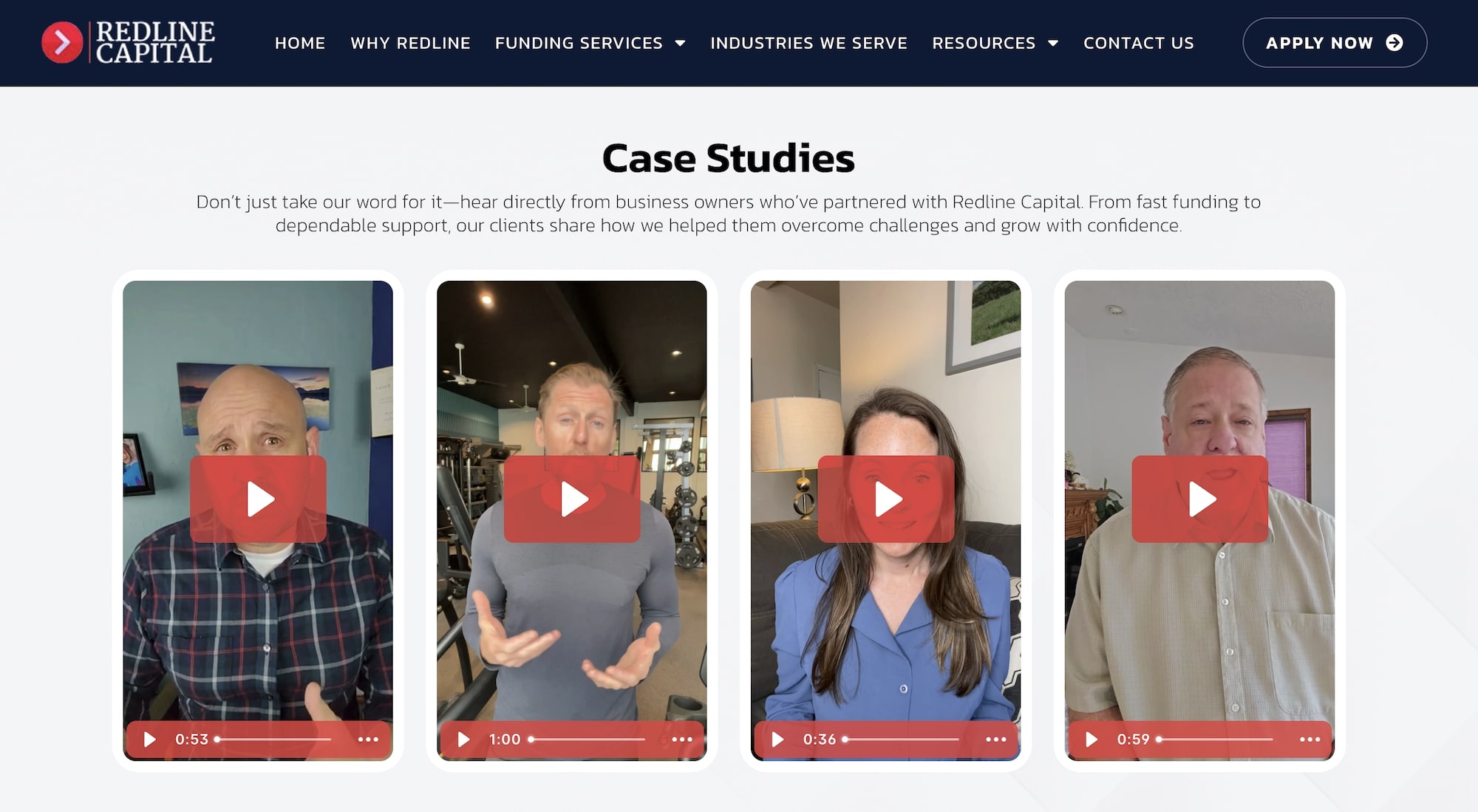
Watch our case study videos to hear what clients say in their own words:
Complete this application form to see what terms and rates you qualify for. We’ll send you multiple offers for dental practice loans, including working capital loans, term loans, business lines of credit, and equipment financing.
FAQs
How do I get a dental practice loan?
The first step is to decide which type of lender you want to use. If you go for a traditional bank, you need to prepare a strong business plan, gather all necessary financial documents, and demonstrate a solid credit history and reliable cash flow to lenders. This is a time-consuming process, so start as early as possible by speaking with several banks to understand their specific requirements and build a relationship before applying for a loan. The whole loan process may take weeks or even months to complete.
If you opt for a lender offering revenue-based financing, the process is considerably easier and faster. Typically, these lenders only ask for a few months of bank statements to evaluate your business’s revenue, and you can get the funds within 24 hours.
What interest rates should I expect for dental office loans?
Interest rates for dental practices depend on several factors:
- Credit score: Typically, businesses with higher credit scores can receive offers with lower interest rates, while those with lower scores are more likely to only get offers with higher interest rates.
- Loan type: Different loan types have different interest rate structures. For example, SBA loans and commercial real estate loans may offer more favorable fixed rates but take longer to complete, while revenue-based financing has higher rates but faster approval times.
- Loan amount: The amount can also influence interest rates. Larger loans tend to have higher rates due to increased risk.
- Loan term: Longer repayment terms can reduce monthly payments but often result in higher interest rates.
- Type of lender: Rates vary between lenders, so it is important to shop around and compare offers to find the most competitive rate.
What are the requirements to qualify for a dental practice loan?
To qualify for a dental practice loan, you must have a strong credit history, a solid business plan, stable income, and a low debt-to-income ratio. Lenders will also assess your experience and may require collateral, such as equipment or property, to secure the loan.
You must be prepared to provide a variety of documents, including personal and business tax returns, financial statements (profit and loss, balance sheets, cash flow statements), and bank statements, among others. If applying for a secured loan, you will need documentation for the assets you’re using as collateral.
In contrast, if you’re applying with a revenue-based financing company like Redline Capital, the process is much easier: we only ask for proof of income (earn $30,000 per month), be in practice for 12 months or more, and be located in the U.S.