


SaaS companies are increasingly turning to revenue-based financing as an alternative to bank loans.
That’s because banks have strict, often unrealistic requirements. You need near-perfect credit, hard assets for collateral, stable profits, years of tax returns, and significant cash reserves to qualify.
Many SaaS companies in the growth stage reinvest heavily and don’t fit that mold. They typically have intangible assets (e.g., software, IP, customer relationships), negative profitability, and no hard collateral.
On top of that, SaaS companies that do qualify face a 60 to 90-day wait for funding, due to the volume of requirements and paperwork banks must underwrite.
Revenue-based financing solves both problems because it’s easier to qualify for and can close much faster than bank loans.
So, we wrote this guide to help SaaS companies learn more about revenue-based financing. We explain how revenue-based financing works, what you need to qualify, and how to find the right revenue-based lender.
We also compare revenue-based financing to other common alternatives so you can evaluate all your options.
- What is revenue-based financing?
- How does revenue-based financing work?
- How to apply for revenue-based financing
- How to choose the right financing provider and secure the best offers
- Revenue-based financing alternatives for SaaS businesses
Submit 4 months of bank statements and we’ll email you revenue-based financing offers that you qualify for, with the option of funding as early as today or tomorrow.
What Is Revenue-Based Financing?
Revenue-based financing is a financing solution that evaluates and approves your loan application based solely on your monthly recurring revenue (MRR). All you need to do to qualify is meet the revenue requirement of the lender you’re applying with.
Revenue-based financing lenders don’t scrutinize your personal credit, profit margins, collateral, or tax returns like banks.
This revenue-based approach offers four main advantages over bank loans and venture capital:
- It’s easier to qualify: Approval depends on your monthly recurring revenue, not the demanding criteria banks impose or the months-long diligence process of venture capital firms.
- You get funded faster: Because lenders evaluate your revenue rather than a full financial profile, underwriting takes hours rather than months. As a result, most revenue-based financing companies can fund within 3 to 5 days. At Redline Capital, we can fund even faster, typically on the same day you apply.
- You secure larger loan amounts: Revenue-based financing providers advance up to 200% of your monthly revenue, while banks rarely lend more than 50%.
- It’s non-dilutive: Unlike venture capital or angel investment, revenue-based financing does not require giving up ownership.
- No personal risk: Bank loans usually require borrowers to pledge personal assets as collateral, such as their home, vehicle, or savings. If you default, the lender has the right to seize them. Revenue-based financing doesn’t require collateral, so your personal assets are never on the line.
Read more: Why Use Revenue-Based Financing Instead of Debt Financing?
How Does Revenue-Based Financing Work?
Revenue-based financing lenders provide a lump sum upfront, typically 150% to 200% of your monthly revenue, and you repay a percentage of your revenue over time until you reach a pre-agreed total.
That total amount is determined by a factor rate, which is a multiplier applied to the amount you borrow. For example, if you borrow $100,000 at a factor rate of 1.1, you repay a total of $110,000. Unlike an interest rate, the factor rate doesn’t compound over time; the repayment amount is fixed from day one.
Revenue-based financing suits SaaS firms with strong recurring revenue but that are unable to meet bank criteria.
Requirements to Qualify for Revenue-Based Financing
Depending on the lender you apply with, the monthly revenue requirement you have to meet to qualify will vary.
At Redline Capital, our revenue requirement is $30,000 per month and the only paperwork we ask for is four months of bank statements that confirm your revenue. If your SaaS company generates $30,000 per month or more, you qualify.
Because of this straightforward approach, over 80% of the SaaS businesses that apply with us qualify, compared to an industry-wide bank approval rate of around 13%.
Compare these requirements to that of banks, which asks for:
- A credit score of 720 or higher
- Several years of operating history
- Strong gross margins
- Low debt-to-income ratios (often below 35%)
- Significant cash reserves
- Personal guarantees, real estate, or other hard collateral
- Clean tax filings with no outstanding 941 liabilities
- Detailed financial statements, business plans, and cash flow forecasts
- Low customer churn and excellent retention rates
How to Apply for Revenue-Based Financing
The application process will look a little different depending on the lender, so we can’t speak for everyone. Here’s how it works with Redline Capital:
- Submit four months of bank statements. This is the only document we require. It shows us your revenue stream, and from there, we can determine what you qualify for.
- We run a soft credit check. Having bad credit doesn’t disqualify you, but it helps us determine the rates you qualify for. Our underwriters also review your four months of bank statements, using your monthly recurring revenue to assess how much you can qualify for.
- We email you multiple offers within a few hours. Each offer shows the financing amount you qualify for, the total amount you have to repay, the repayment schedule, and the payment frequency (daily, weekly, bi-weekly, or monthly payments).
- You choose an offer and confirm via email. Once you accept, funds are deposited into your bank account within hours. The entire process, from submitting your bank statements to receiving capital, typically takes less than 24 hours.
- Use the funds to grow your SaaS business or settle urgent expenses: We place no restrictions on how you can use your funds. You can invest in product development, use it as growth capital, settle payroll, or launch a new marketing campaign.
Read more: How to Apply for Revenue-Based Financing
How to Choose the Right Revenue-Based Financing Provider and Secure the Best Offers
Despite the benefits of revenue-based financing, not all providers are created equal.
The one you choose can mean the difference between securing affordable, transparent financing and getting locked into an expensive deal. Here’s how to choose the right revenue-based financing provider:
- Are they a direct lender or broker?
- Do they pressure you to accept their offer, do they give you the space to make a decision?
- Do they have experience funding subscription-based businesses?
Are They a Direct Lender or Broker?
Most founders assume that going directly to a lender cuts out broker fees and gets them better terms.
However, a quality broker such as Redline Capital can often secure better rates and higher loan amounts than any individual business can access on its own.
That’s because we send our lending partners a large, consistent volume of qualified applications ($100+ million annually). This is far more than any single borrower contributes. That kind of volume helps lenders scale their business and hit their targets faster than they could on their own.
In exchange for all this business, lenders offer our clients preferential rates, higher loan amounts, discounts, and flexible terms that they do not extend to direct applicants. Our clients benefit significantly from the business we send to our lending partners.
Partnering with Redline Capital also comes with a few additional advantages:
- Emergency funding available: We have strong relationships with specific loan officers working at our lending partners, so we can call them to get things moving rather than submitting a formal application. That translates to extremely fast financing. For example, we’ve successfully funded SaaS businesses that needed to make payroll in under 4 hours.
- Less paperwork for you: You can submit one application and get offers from multiple lenders. Applying to lenders directly means you have to fill out separate applications.
Read more: Top 6 Accounts Receivable Financing Companies
Do They Pressure You to Accept Their Offer, or Give You Space to Make a Decision?
How aggressively a lender pushes you to accept is a reliable signal of the quality of their offers.
Lenders confident in the competitiveness of their terms have no reason to rush you. They’ll give you time to review them and encourage you to shop around. Those who offer expensive terms will try to manufacture urgency to stop you from comparing and make a decision quickly.
Some low-quality lenders will tell you the offer is about to expire, that rates are going up, or that another applicant is eyeing the same funds. These are all tactics designed to force a fast decision. That kind of pressure is a sign of expensive, perhaps predatory rates.
At Redline Capital, we send you the offers you qualify for and step back. We are confident enough in our terms that we actively encourage you to shop around and compare. We want you to fully understand what you are agreeing to before you commit.
Do They Have Experience Funding Subscription-Based Businesses?
Lenders without SaaS experience will often treat standard industry characteristics as red flags specific to your business. High customer acquisition costs, negative working capital during growth phases, or long B2B sales cycles are all normal in SaaS.
However, to a lender that primarily works with asset-heavy or product-based businesses, these metrics can raise concerns, leading them to raise your rates or decline your application.
At Redline Capital, we work with B2C and B2B SaaS companies across tech, fintech, edTech, and more. We understand how the model operates, and we will not penalize you for industry-standard characteristics.
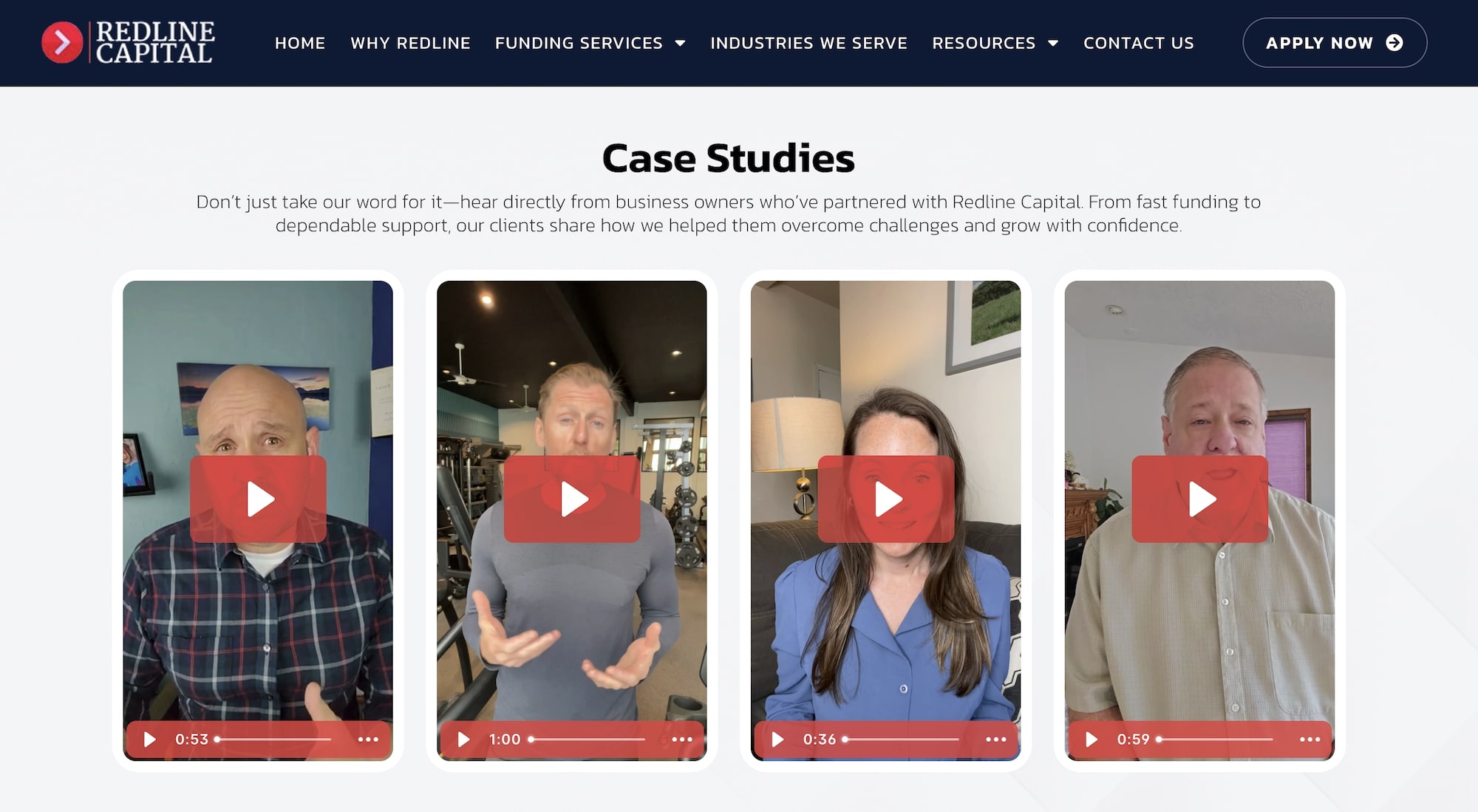
Here’s what SaaS founders say about working with Redline Capital:


Visit our case studies page to hear our clients’ experiences with Redline Capital:
Revenue-Based Financing Alternatives for SaaS Businesses
Bank Loans
Traditional loans offer the lowest cost of capital, typically 6% to 15%, but carry the most demanding qualification criteria and the longest approval timelines. Banks typically ask for:
- A near-perfect personal credit score
- Several years of operating history
- Strong profit margins (a challenge for many scaling SaaS businesses)
- Low debt-to-income ratios (often below 35%)
- Significant cash reserves
- Personal guarantees
- Detailed financial statements, business plans, and cash flow forecasts
- And excellent annual recurring revenue (ARR)
Securing a traditional loan from a bank usually takes between 60 to 90 days, which is impractical for SaaS companies that need funds urgently.
To apply for a bank loan, you’ll need to schedule a call with a loan officer, explain your business model and how you intend to use the funds, collect and submit a full documentation package, then wait 60 to 90 days for underwriting.
Venture Capital
Venture capital firms provide large capital injections and strategic support in exchange for equity, typically targeting SaaS companies with strong growth metrics and a clear path to a significant exit.
Equity financing is well suited to founders comfortable giving up ownership and board control in exchange for capital and strategic support. It is not practical for SaaS founders who want to remain in full control of their company, or are not building toward a venture-scale outcome.
The process of securing venture capital is also much longer than bank loans, typically taking three to six months from first meeting to funding. You’ll need to spend months crafting your pitch, securing warm introductions, and working through multiple rounds of due diligence, all while running your business.
Venture Debt
Venture debt is a term loan for venture-backed or high-growth SaaS companies. Unlike regular bank loans, it doesn’t need years of profits or hard collateral. Lenders focus on your investors, revenue growth, valuation, and path to profitability.
Founders typically use venture debt alongside or immediately following an equity round to extend runway without triggering additional dilution.
The main appeal of venture debt is that it gives founders access to capital while preserving more equity than another funding round would require. For SaaS companies that have already raised institutional capital and want to push further without giving up more ownership, it can be a practical bridge between rounds.
However, this type of SaaS financing is primarily for companies backed by recognized venture capital firms. Without this, most lenders won’t approve you.
In addition, lenders impose financial covenants that your business must continue to meet throughout the loan term. Missing them can trigger default or force early repayment.
Angel Investors
Angel investors deploy their own capital into early-stage companies in exchange for equity. These investments are typically smaller than venture capital rounds, around $25,000 to $500,000, and the process can be faster and less formal.
While angel investors can help SaaS entrepreneurs access capital and expertise, it involves equity dilution and introduces a stakeholder with financial interest in your decisions, something that revenue-based financing eliminates.
Additionally, finding the right angel investor often takes months of networking and pitching, ruling it out for SaaS companies who need funds immediately.
Invoice Factoring
Invoice factoring is a method of fundraising that lets you sell outstanding invoices to a third party for around 70% to 90% of its value and get immediate cash. The factoring company then collects payment directly from your clients and pays you the remaining amount minus a 1% to 5% factoring fee.
Invoice factoring is best for B2B SaaS companies billing enterprise clients on long net payment terms, and isn’t an option for B2C companies.
The main drawback of invoice factoring is that it’s based on your clients’ creditworthiness and balance sheets rather than yours. This can make it unreliable if your client base is small, early-stage, or inconsistent in their payment history.
Merchant Cash Advances
A merchant cash advance provides a lump sum upfront in exchange for a percentage of future revenue, automatically deducted from your deposits on a daily or weekly basis.
Merchant cash advances can be much quicker than most types of financing, often within 24 to 48 hours, and require minimal documentation. As a result, they tend to be popular among SaaS companies who need instant cash, perhaps to cover payroll, fund an urgent marketing push, or keep operations running during a slow month.
However, merchant cash advances carry a higher cost than most other financing options. Factor rates typically range from 1.18 to 1.49, meaning a $100,000 advance requires repaying $118,000 to $149,000. They are better suited to short-term, urgent needs than sustained growth financing.
Read more: 10 Merchant Cash Advance Alternatives & How to Choose
SBA (Small Business Administration) Loans
SBA (Small Business Administration) loans are government-backed loans designed for small businesses, offering interest rates below conventional bank loans and repayment terms of up to 25 years.
The SBA does not lend directly. It guarantees a portion of the loan, making banks more willing to extend credit.
However, the tradeoff is time and paperwork. The approval process takes 60 to 90 days or longer, and applicants must meet SBA eligibility requirements along with the bank’s own criteria. SBA loans make the most sense for established SaaS businesses with time to navigate the process and a need for larger capital amounts.
Get Same Day Revenue-Based Financing for Your SaaS Business
Apply with Redline Capital in less than five minutes. Provide four months of bank statements, and within one to two hours we send you financing offers, with same day funding available for businesses that qualify.
FAQs
How does revenue-based financing work?
A lender extends capital to your business upfront, and you repay it over time until you reach a pre-agreed total amount. That total is determined by a factor rate, a simple multiplier applied to what you borrow. For example, borrow $100,000 at a factor rate of 1.1 and you repay a total of $110,000.
What are the benefits of revenue-based financing for SaaS companies?
Revenue-based financing offers several advantages over traditional funding options. Namely, it’s easier to qualify for than bank loans because approval is based on monthly recurring revenue (MRR) rather than credit scores, profit margins, or hard assets. Funding is also significantly faster, with some providers closing the same day you apply compared to the 60–90 days banks typically take.
What does RBF mean in business?
RBF stands for revenue-based financing. It’s a form of business lending where a lender evaluates and extends capital based primarily on a company’s monthly revenue, rather than the credit scores, collateral, and profitability metrics that traditional lenders require. Repayment is tied to a pre-agreed total amount determined by a factor rate applied to the loan.
How can I finance my startup?
There are several options for SaaS startups depending on their stage and needs. Bank loans offer competitive rates but have strict requirements and slow timelines that most early-stage companies can’t meet. As a result, revenue-based financing is becoming more popular with startups that have strong revenue streams.
How does venture capital work?
Venture capital firms invest money into early-stage or growth-stage companies in exchange for equity. Founders receive capital to grow, along with the investors’ network and guidance. However, raising venture capital is a lengthy process that involves pitching multiple firms, going through extensive due diligence, and negotiating terms, often over the course of several months with no guaranteed outcome.