


Inventory financing can help retailers access quick funds to purchase stock and fill up their shelves. Retailers commonly use it to:
- Restock bestsellers while their working capital is tied up in unsold inventory
- Capitalize on bulk purchase discounts from wholesalers
- Prepare for busy seasons and surges in customer demand
- Fund growth into new product lines
Inventory financing providers typically care less about business metrics like cash reserves, collateral, and profit margins, and more about the value and shelf life of the inventory itself. That makes inventory financing easier to qualify for than traditional business loans.
Below, we cover the most common types of retail inventory financing solutions, the requirements you need to meet to qualify, what paperwork to prepare, and how to apply.
Along the way, we show you how Redline Capital can fund your inventory purchase the same day you apply, with just four months of bank statements.
Submit four months of bank statements and receive financing offers that can fund on the same day you apply. Our application takes less than five minutes and won’t affect your credit score.
How Does Retail Inventory Financing Work?
Most inventory financing options follow this process. First, you submit an application along with inventory data such as product lists, turnover rates, and basic business financials.
Next, the lender underwrites your application, evaluating how quickly you sell your inventory and how easily they could resell it if needed. They then offer you an advance based on the appraised value.
Loan-to-value ratios typically range from 50% to 80% of the inventory’s value, depending on inventory type, turnover speed, and market demand.
So if your inventory costs $100,000, the lender will typically finance $50,000 to $80,000, with the remaining $20,000 to $50,000 due as a down payment. However, as we cover below, Redline Capital can finance up to 100% of your inventory costs.
Types of Inventory Financing for Retailers
Retailers can use several business financing options to fund inventory purchases. The right option depends on how much capital you need, your timeline, the level of repayment flexibility you want, and what your business qualifies for.
- Term loans are larger, longer-term business financing options typically used to make significant inventory investments such as bulk orders, expanding into new product categories, or consolidating existing debt. Repayment periods generally range from one to five years.
- Working capital loans are short-term loans, typically 6 to 24 months. These are typically smaller in size than term loans, and businesses commonly use them to restock fast-moving items, top up inventory before a promotion, or cover the cost of a smaller reorder.
- Purchase order financing is a funding type tied to a specific confirmed purchase order. A lender advances capital so you can fulfill the order, and you repay once your customers pay. This is useful when you have large incoming orders but lack the immediate cash to stock up.
- Revolving lines of credit provide revolving access to a set credit limit that you can draw from as needed and repay over time, giving you ongoing liquidity. Interest accrues only on the amount you draw, making it a flexible option for seasonal retailers whose inventory needs fluctuate throughout the year.
Requirements to Qualify for Retail Inventory Financing
Requirements for inventory financing vary significantly depending on the type of lender you apply with. Banks are the most common starting point for most retailers, so we’ll look at their process first.
Banks offer inventory financing products that, in theory, are supposed to place greater weight on your inventory rather than your business. But their risk-averse nature means you still have to meet demanding requirements.
This often includes having excellent personal credit, strong profitability, years of documented financials, collateral, accounts receivable reports (if applicable), and a detailed business plan, among other things. Banks may also ask about your inventory management system, inventory turnover, and seasonal fluctuations.
From our conversations with retailers, most struggle to qualify. The data backs this up because only 13% of businesses that apply for bank loans qualify.
In contrast, at Redline Capital, we designed our requirements to be straightforward and realistic:
- $30,000 in monthly revenue
- One year in business
- A U.S.-based operation
Because our main focus is your monthly revenue, you don’t need a spotless credit history, strong profit margins, consistent cash flow, collateral, cash reserves, or any of the other things banks typically require. As a result, our loan approval rate is more than 80%.
In addition to being easier to qualify for, these simple requirements also offer the following benefits:
- Larger loan amounts: Banks rarely lend amounts that reflect your actual revenue potential, typically capping loans at 50% of monthly revenue or less. On the other hand, Redline Capital can approve funding up to 200% of your monthly revenue.
- Faster closing times: Fewer requirements mean less paperwork and less time spent underwriting your application. All we need are 4 months of bank statements, and in most cases, we can close the same day you apply.
- No down payment: Banks often require a down payment of 20% to 50% of the loan amount before approving your application. Because we focus on your monthly revenue rather than the value of assets you can put up front, we do not require a down payment.
How to Apply for Retail Inventory Financing
When you apply for retail financing at a bank, you’ll need to book an appointment with a loan officer to explain your business, your situation, and how you plan to repay the loan amount.
The loan officer will give you a list of required documents to gather, which typically include tax returns for the past 2 to 3 years, balance sheets, profit and loss statements, financial projections, inventory levels, and a formal business plan.
Once you submit these documents, the bank starts evaluating and underwriting your application. Given the volume of paperwork involved, that process typically takes 60 to 90 days, long enough to miss an entire peak season.
To get the best rate, you’ll need to shop around and approach at least two or three banks, which means going through this entire process again for each one.
With Redline Capital, however, you can apply in 5 minutes and get funded on the same day. Here’s what our application process looks like:
- Submit four months of business bank statements and fill out a short application with basic information about your business. No tax returns, profit and loss statements, or inventory reports required.
- Our underwriters review your bank statements and send you multiple financing offers within one to two hours. Each offer clearly outlines the funding amount, repayment amount, term length, and payment frequency.
- Review the offers at your own pace. We never pressure you into accepting. Feel free to take as much time as you need, or choose another lender if they offer more competitive quotes.
- Once you accept an offer, we wire funds into your business bank account the same day. In most cases, the full process from application to funding takes under 24 hours. In urgent situations, we have funded retailers in as little as 4 hours.
How to Choose a Retail Inventory Lender
Are they a broker or a direct lender?
A common misconception in business lending is that going directly to a lender gets you the best deal because it eliminates broker fees.
However, partnering with a high-quality broker lets you leverage the volume of business they’ve sent to their lending partners. That way, you can secure better rates and terms than you could by applying on your own.
For example, Redline Capital has spent over a decade building relationships with top inventory financing lenders, including OnDeck, Rapid Finance, and Headway Capital. We send hundreds of millions of dollars in loans their way each year, growing their lending business.
That volume gives us leverage to secure preferred pricing, larger loan amounts, and discounts for our clients that they don’t offer borrowers who apply directly.
In addition, if your application falls into a gray area that a lender would not normally approve, we can use our relationships to negotiate on your behalf and secure exceptions. Lenders rarely negotiate with individual borrowers.
Do they have expertise working with retailers?
We recommend evaluating whether a lender has genuine experience working with retail businesses before you apply.
That’s because retail has financial characteristics that less experienced lenders often misread as weaknesses specific to your business.
For example, thin profit margins are the norm in retail as the business model depends on volume, not high markups. Yet, many banks and inexperienced lenders flag thin profit margins as poor performance rather than an industry standard.
Other examples include seasonal revenue swings, slow-moving inventory periods, and the gap between purchasing and selling cycles. These are also misunderstood by lenders who have not worked with retail businesses before.
At Redline Capital, we have spent years working with retailers across all categories (e.g., grocery, apparel, electronics, home goods, e-commerce). Because we understand how retail businesses actually operate, we will not reject or overprice your application for the characteristics that define your industry.
Do they pressure you to accept one of their offers?
Many inventory financing lenders use aggressive tactics the moment you submit an application. Follow-up calls, expiring offers, and urgency messaging are all designed to rush you into accepting before you have had time to compare your options.
It’s no surprise that these offers are of poor quality, typically having higher interest rates, shorter repayment plans, and terms that don’t account for seasonal demand.
At Redline Capital, we email you the offers you qualify for and leave the decision entirely to you. There are no countdown timers, no pressure calls, and no obligation to accept. We want you to fully understand the rate, fees, and payment schedule before you commit to anything.
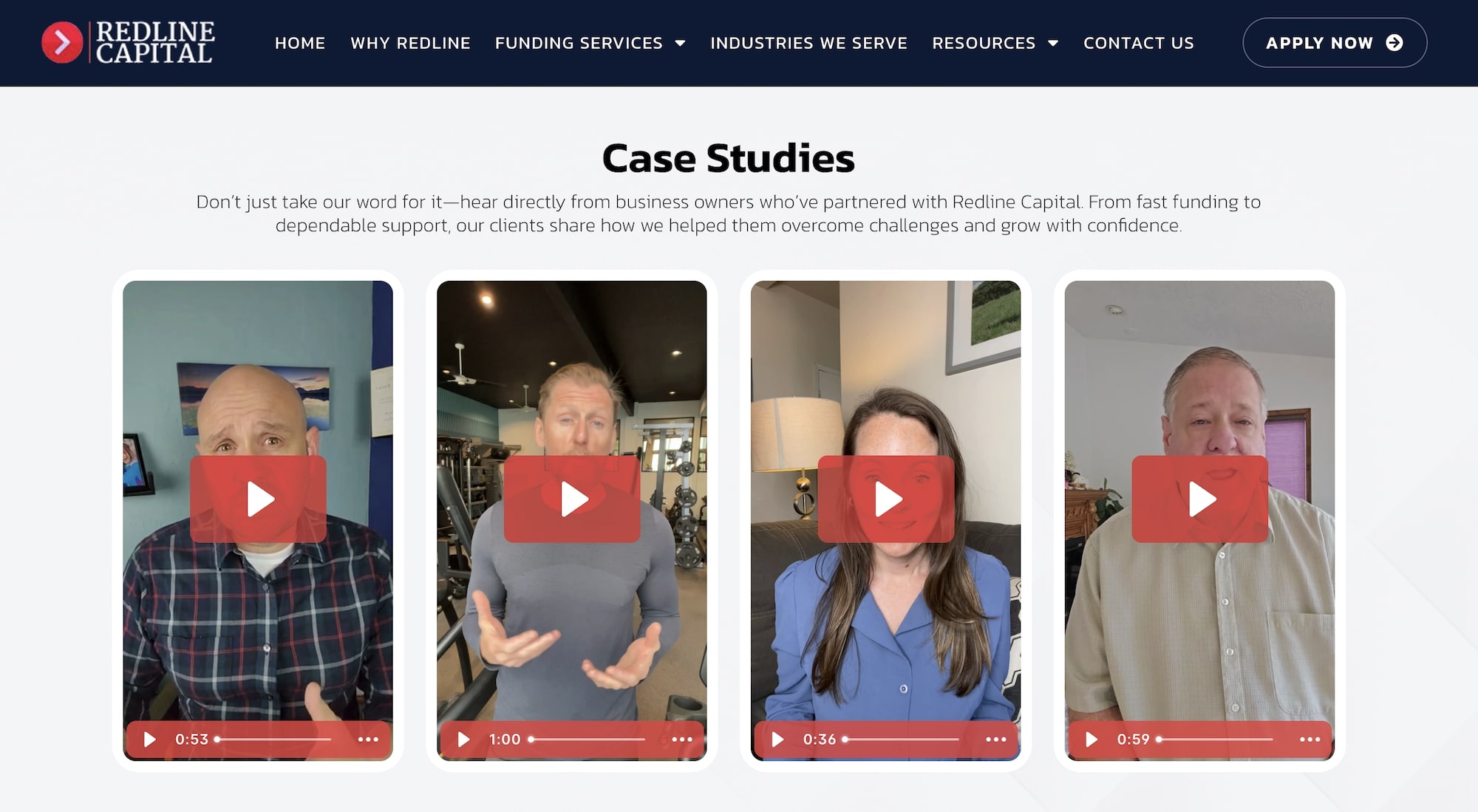
Here’s what business owners say about our lending process and speed:


Visit our case studies page to see what our clients have said:
Retail Inventory Financing Alternatives
Invoice Factoring
Invoice factoring allows retailers to sell outstanding invoices to a factoring company at a discount. The factoring company advances 70% to 90% of the invoice value upfront and collects payment directly from your customers when the invoice is due. Factoring fees typically range from 1% to 5% of the invoice value per month.
The main advantage of invoice factoring is that it’s faster than bank financing, typically closing within a week or two.
However, factoring companies base approval on your customers’ creditworthiness rather than your own, making it unreliable if your client base includes startups, small businesses, or businesses with less-than-spotless payment histories.
Merchant Cash Advances
A merchant cash advance (MCA) provides a lump sum upfront in exchange for a percentage of your future revenue. Repayment is automatic, deducted from your daily or weekly bank deposits until the advance is repaid.
MCAs can be funded within 3 to 5 days and have straightforward qualifications, but they cost more than most other financing options.
Corporate Credit Cards
Business credit cards offer revolving credit for inventory purchases. They are easy to access and often offer rewards programs.
The main limitation is credit limits. Most business credit cards often don’t extend enough credit to fund large inventory purchases. Carrying a high balance can also affect your credit utilization ratio and make it harder to qualify for other financing down the line.
Supplier Trade Credit
Many suppliers offer trade credit, allowing retailers to purchase inventory now and pay 30, 60, or 90 days later. This is one of the most accessible forms of inventory financing because it does not require a formal application with a lender.
Availability and terms depend entirely on your relationship with the supplier and their willingness to extend credit. It works well as a complement to other financing options, but cannot always be relied on as a standalone solution. That’s because not all suppliers offer it, and those that do often limit the credit amount or reserve it for long-standing customers with a strong payment history.
Get Same-Day Retail Inventory Financing With Redline Capital
Ready to fund your next inventory purchase? Apply with Redline Capital in less than five minutes. All we need is four months of bank statements to get started, and businesses that qualify can close the same day.
FAQs
How does inventory financing work?
A lender provides capital to purchase inventory, and as you sell your inventory, you repay the loan amount. Most lenders evaluate your inventory’s value and turnover rate, advancing 50% to 80% of its appraised value. With revenue-based financing, lenders base approval on monthly revenue and skip the inventory valuation entirely.
What are the risks of inventory financing?
If your inventory does not sell as fast as you projected, repayment becomes difficult. Traditional inventory loans use inventory as collateral, meaning lenders can seize it upon default. Buying the wrong product mix or overstocking can create a debt cycle that is hard to exit.
Is an inventory loan right for my business?
Inventory financing works best for retailers with consistent sales and predictable restocking cycles. If your inventory moves reliably and you need capital to restock or prepare for peak seasons without depleting working capital, it is likely a strong fit.
What are the steps involved in getting an inventory financing loan?
Steps vary by lender. Banks require an appointment, extensive documentation, and 60 to 90 days of underwriting. With Redline Capital, you submit four months of bank statements, receive offers within hours, and can get funded the same day.
What are the benefits of using inventory financing for retail businesses?
Inventory financing helps retailers restock fast-moving products, prepare for peak seasons, and capitalize on bulk purchase discounts without depleting working capital. Through revenue-based financing, you can qualify without collateral, strong profit margins, or a lengthy underwriting process.