


Texas businesses regularly turn to a line of credit to smooth out cash flow because it’s one of the more adaptable financing options available.
A line of credit’s biggest edge over a regular bank loan comes down to the fact that it’s revolving. You draw only what you need, pay interest on that amount, and once you repay it, the credit becomes available again; no reapplying required.
It’s also not tied to a specific purpose the way many loans are. A line of credit can cover payroll one month and a supplier discount the next, giving you one working capital source instead of separate financing for every need.
Those advantages aside, where you source your line of credit matters, since it impacts how high a bar you have to clear to qualify, how fast you get funded, and the rates and credit limits you can secure.
So, before choosing a line of credit lender, it’s worth checking a few things.
- Start with their eligibility requirements. Most Texas banks have strict criteria that disqualify most companies before they even get considered (e.g., perfect credit, low debt, strong profitability, personal guarantees, 2+ years in business). Look for a lender with simpler criteria, so you have an actual shot instead of an automatic rejection.
- Don’t take a lender’s advertised closing speed at face value. Many promise fast funding on their website, then the process drags on for weeks once you’re actually in it. A more reliable signal on funding speed is how much paperwork they ask for. More paperwork means longer underwriting, and a longer wait for your funds.
- Pay attention to whether they rush you to accept their offer. A lender with high-quality offers is confident in its pricing and has no reason to rush you. They’ll welcome you to compare offers and think it over. A lender that pressures you to sign usually doesn’t want you shopping around because their offer is expensive.
- Check what credit limit you’d actually qualify for. Many lenders cap lines of credit at $5,000 to $15,000, or a small percentage of your monthly revenue. You could get approved and still not have enough available credit to cover expenses like payroll, inventory, rent, or equipment purchases.
- Decide whether you’re comfortable with a personal guarantee. Secured lines of credit can come with a lower APR in exchange for pledging business or personal assets, while unsecured lines of credit avoid that risk but may cost more. Know which trade-off you’re making before you sign.
We put this guide together to help Texas businesses qualify for lines of credit, get funded quickly and without drama, and secure the lowest rates available.
Use our loan calculator to pull instant quotes and see the rates, terms, and credit limits your business qualifies for.
1. Redline Capital: Same-Day Business Lines of Credit at Competitive Rates

Redline Capital is a revenue-based financing lender that has helped countless Texas small business owners secure the capital they need to cover cash flow gaps and continue operating. This includes those that banks and credit unions turned away for not meeting their strict requirements.
We’ve funded businesses across a wide range of industries, including:
- Restaurants and retailers
- Medical and dental practices
- Staffing agencies
- Construction companies
- Security companies
- HVAC businesses
- Auto repair shops
- Law firms and consultants
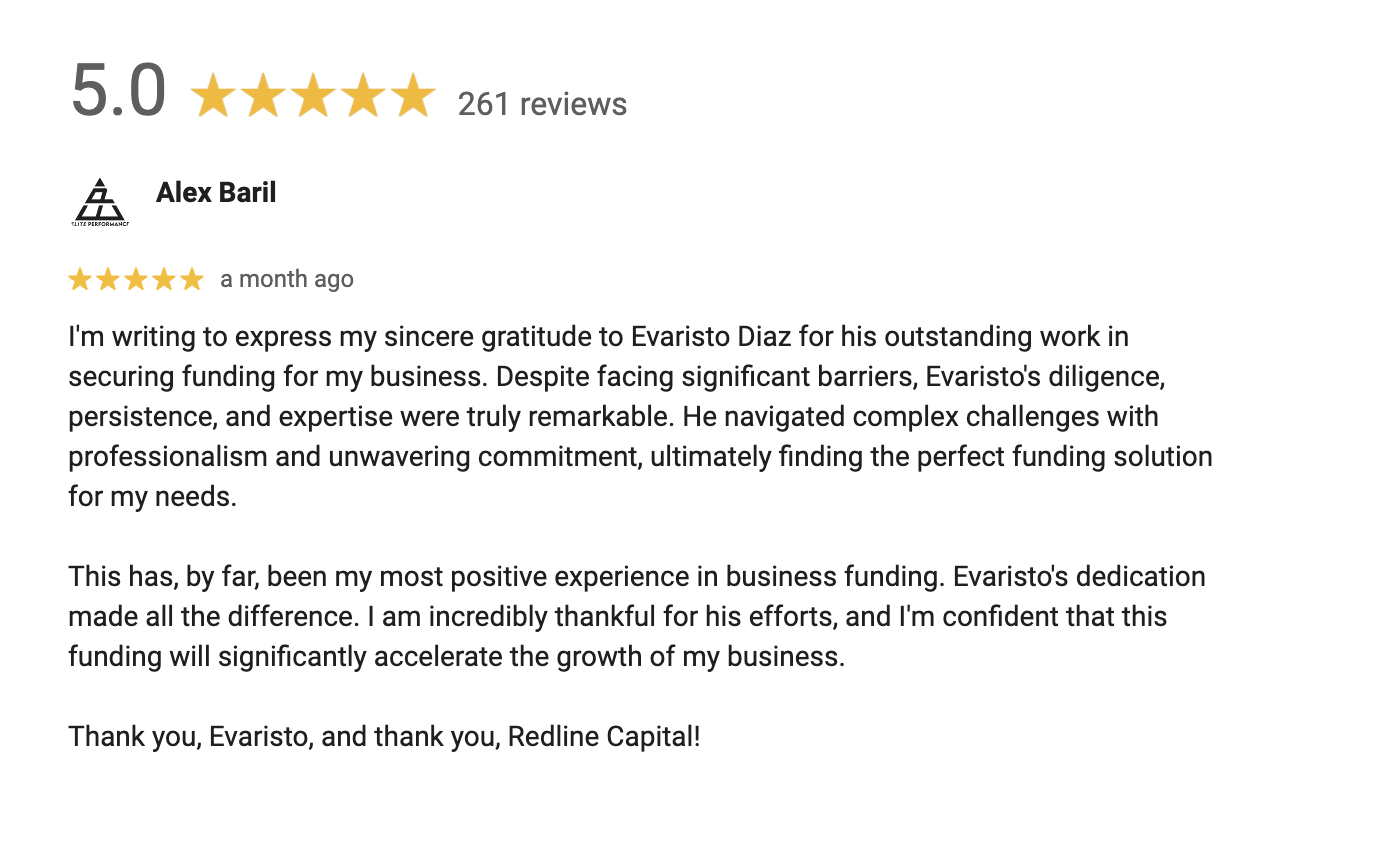
Here’s how borrowers describe their experience with Redline Capital:


Criteria #1: Our Qualification Is Straightforward: 80%+ of Businesses Get Approved
We designed our qualification criteria to be simple and accessible, with revenue mattering more than anything else.
If your business generates $30,000 or more a month, has been operating for at least 12 months, and is based in the U.S., you’re in a great position to qualify. Unlike banks and credit unions, we don’t require near-perfect credit scores, strong profitability, cash reserves, or personal guarantees.
That’s a meaningfully lower bar than what banks and credit unions ask for, and it shows in the numbers. Only 13% of applicants get approved for business loans at a bank, while we approve more than 80%.
Criteria #2: Minimal Paperwork Means Same-Day Funding
Fewer requirements also mean less paperwork for us to underwrite. There’s no credit history to dig through, collateral to appraise, or years of financials to comb over.
All we ask for is four months of bank statements to verify your revenue. That’s enough for us to send you an offer within hours and get funds in your account the same day you accept.
Criteria #3: We Never Rush You to Sign Our Offers
The clearest warning sign of a bad offer is a lender who won’t give you time to evaluate it. If they don’t let you shop around and instead lean on underhanded tactics (e.g., repeated calls and emails, invented deadlines), their offer is likely expensive, or even predatory.
We work differently. Once we send an offer, you’re free to review it, compare it elsewhere, and decide on your own timeline with no pressure.
We can afford to do this because of the quality of our offers. We’re an established broker with strong relationships with top lenders, including OnDeck, Headway Capital, and Rapid Finance. We’ve sent them millions of dollars in qualified business, growing their operation in the process.
In exchange for all our business, they offer our applicants better rates and terms than what a business would get by applying directly.
That pricing advantage is exactly why we don’t need pressure tactics. We know that once businesses compare our offer against everyone else’s, they’re likely to come back to us.
Criteria #4: Our Credit Limits Go Up to $750,000, or 200% of Your Monthly Revenue
Getting approved doesn’t mean much if the credit limit you receive can’t actually cover what you need. Banks and credit unions typically cap their lines of credit at $5,000 to $15,000, or a small percentage of your monthly revenue. That’s because they’re inherently risk-averse, and they size their limits to protect their own money, not to match what your business actually needs.
We take a different approach. Because we underwrite based on revenue alone, without capping you based on credit, collateral, or profit margins, we can extend credit lines up to $750,000, or as much as 200% of your monthly revenue, typically enough to comfortably settle payroll, inventory, and other recurring expenses.
Criteria #5: We Offer Both Secured and Unsecured Lines of Credit
Many lenders require you to personally guarantee the debt or pledge business assets as collateral in exchange for a lower rate.
That trade-off can make sense if you have strong collateral to offer and want a lower rate in exchange, but it also means your personal finances or the equipment and property you rely on to operate are on the line if your business can’t repay what it draws.
We offer both options. If you’d rather not put anything up, our unsecured line of credit is approved on revenue alone, no personal guarantee or collateral required. If you have assets you’re comfortable pledging and want a lower rate in exchange, our secured line of credit gives you that choice too.
Alternatives Line of Credit Lenders to Consider in Texas
We built our process to fix the problems we consistently see with other lenders —slow funding, strict requirements, and expensive rates — so most Texas businesses find us to be a strong fit. That said, we always encourage comparing options, so we’ve included a few alternatives below.
Frost Bank

Founded in 1868 in San Antonio, Frost Bank is one of the oldest and most established banks in Texas and currently has 100 branches across the state. They help businesses access all different types of capital, including lines of credit, business credit cards, short-term working capital loans, and long-term expansion loans.
What we like about Frost Bank is that it operates across the entire state, with locations in San Antonio, Houston, Austin, Fort Worth, and beyond, unlike most banks and credit unions, which tend to stick to just one region or city in Texas.
Its business line of credit starts at $5,000, with interest-only monthly payments based on a variable interest rate. Frost’s status as an SBA Preferred Lender means its own team can make credit decisions in-house rather than waiting on outside approval.
To apply, a business needs to gather the current and previous year’s tax returns and a personal financial statement for its principals. Depending on the size of the request, it may also need two to three years of financial statements along with accounts receivable and accounts payable aging.
That documentation adds up quickly and can delay funding. Decisions also run through a dedicated local banker rather than an automated online process, which can work well for a business that wants a relationship, but it means your timeline depends heavily on that banker’s availability and closing efficiency.
Texas Capital Bank

Texas Capital Bank is a commercial bank based in Dallas and is one of the largest regional banks in the U.S., with approximately $33.9 billion in assets as of 2026. But despite its size, it positions itself as a flat, low-bureaucracy option for businesses looking for fast funding.
It offers both business loans and lines of credit from $15,000 to $250,000, with larger amounts available through its Business Banking Group. They also offer other loan products, including SBA loans, equipment financing, and commercial real estate loans for businesses that need longer-term or asset-specific financing.
To qualify for a line of credit with Texas Capital Bank, you need a personal credit score of at least 680, a minimum of one year in business, and a Texas Capital Small Business Checking account in good standing.
That checking account requirement means approval alone isn’t enough. A business must also open and maintain a deposit relationship with the bank before funds arrive, adding a step beyond the credit application itself. The 680 credit floor also rules out newer businesses that a revenue-based lender would otherwise consider.
Amegy Bank

Originally Southwest Bank of Texas, Amegy Bank is a Texas-focused regional bank that’s now a division of Zions Bancorporation.
One of its specialty products is a business line of credit tied directly to your business checking account, taking the manual work out of monitoring your balance since funds transfer automatically, and before an overdraft fee is ever charged.
The bank also runs a Small Business Diversity Banking Program aimed at expanding access for minority, women, and veteran-owned businesses, and it holds SBA Preferred Lender status for 7(a) and 504 loans.
Amegy evaluates each business individually through a seasoned banker rather than publishing a fixed set of credit or revenue thresholds. This means bankers have more room to make exceptions and get an application over the line, especially for businesses that already have a relationship with the bank.
But because eligibility isn’t laid out in advance, a business has to start a conversation with a banker to learn whether it qualifies. That relationship-driven process tends to move slower than an automated pricer and online application built for speed.
Education First Federal Credit Union

Education First Federal Credit Union has served Southeast Texas since 1952 and has built a reputation as a go-to for businesses looking for low interest rates.
Its business line of credit works as a revolving facility with interest charged only on the outstanding balance, paired with a business credit card that carries no annual fee. Members get fast access to funds through checks and online banking once approved.
To qualify, you first need to become a member, which requires living, working, or operating in one of the specific Texas counties Education First serves, including Jefferson, Hardin, Jasper, Newton, and Orange. Unlike some of the other lenders on this list, Education First doesn’t operate across the entire state.
That geographic restriction rules out a business anywhere outside that pocket of Southeast Texas, including Dallas, Houston, Austin, San Antonio, or El Paso, regardless of how strong its financials are.
Frequently Asked Questions
How difficult is it to get a business line of credit?
It depends on the lender. Banks in Texas typically approve only a small share of applicants, often requiring near-perfect credit, at least two years in business, and strong financials. That’s why many businesses turn to revenue-based financing instead, since it’s far easier to qualify for when revenue is what matters most.
What is a business line of credit?
It’s a revolving form of financing that lets you draw funds up to a set limit, repay what you’ve used, and borrow again without reapplying. Unlike a term loan, you only pay interest on the amount you actually draw, not the full credit limit.
How do I apply for a business line of credit?
You’ll first have to choose a lender, submit the required financial documents, and go through a credit review. Revenue-based lenders often only require a few months of bank statements, while banks ask for tax returns, financial statements, and personal guarantees, which typically delays funding.
Do I need to be a member to obtain a business loan?
It depends on the lender. Credit unions require membership first, which usually means living, working, or operating a business in a specific service area. Banks and revenue-based lenders like Redline Capital don’t require membership of any kind.
Who can qualify for a working capital line of credit?
Qualification varies by lender, but most look at time in business, revenue, and credit history. Banks set the highest bar, often requiring two or more years in operation and strong credit. Revenue-based lenders focus mainly on monthly revenue, making qualification more accessible.
How does a business line of credit differ from a term loan?
A term loan gives you a lump sum upfront that you repay on a fixed schedule, with interest accruing on the full amount immediately. A line of credit lets you draw only what you need, repay it, and borrow again, paying interest solely on what you use.
What are the requirements for obtaining a business line of credit in Texas?
Requirements vary by lender. Banks typically want a 680+ credit score, two or more years in business, and strong financials. Revenue-based lenders like Redline Capital only require $30,000 or more in monthly revenue and 12 months in operation.
What are the best banks in Texas for obtaining a business line of credit?
It depends on your business’s financial profile. Established businesses with strong credit may do well with Frost Bank or Texas Capital Bank. Newer or smaller businesses often have better luck with a revenue-based lender like Redline Capital, which approves over 80% of applicants.