


Over the past few years, we’ve seen a shift firsthand of more businesses opting for revenue-based financing (RBF) over bank loans. The main reason for this shift is the tightening requirements that banks impose on businesses. They typically expect excellent credit scores, years of profitable operating history, explosive revenue growth, hard collateral, and mountains of paperwork. Given all of this, roughly 13% of businesses that apply for bank loans qualify.
Banks are also very slow to fund. The volume of paperwork they require means you can expect to wait 60 to 90 days for funding.
To help businesses evaluate revenue-based financing as an alternative, we put together this article covering how it works. We’ll outline typical requirements, describe the application process, and share what to consider when choosing a lender so you can secure the best offers.
- What is revenue-based financing and how does it work?
- Key benefits of revenue-based financing
- Requirements to qualify for revenue-based financing
- How to apply for revenue-based financing
- How to choose a revenue-based financing lender
- Revenue-based financing alternatives
Submit four months of bank statements and you’ll receive revenue-based financing offers in your email inbox — with funding available as early as today or tomorrow.
What Is Revenue-Based Financing and How Does It Work?
Revenue-based financing is a type of business loan evaluated on your monthly revenue. It doesn’t factor in your credit score, profit margins, operating history, or whether you have assets to pledge as collateral.
The central question is simple: Does your business generate enough monthly revenue to meet the lender’s minimum threshold? If it does, you qualify. This makes revenue-based funding easier to qualify for because you don’t have to meet the borderline unrealistic requirements of banks.
Here’s how it works in practice. The lender provides a lump-sum payment, typically between 150% and 200% of your monthly revenue. You then repay a percentage of future revenue, either daily, weekly, or monthly, until you reach a pre-agreed total.
That total is determined by a factor rate, which is a metric applied to the amount you borrow. For example, if you receive $100,000 at a factor rate of 1.1, your total repayment is $110,000. Note that factor rates do not compound over time like regular interest rates. The repayment amount is fixed from the day you accept the offer.
5 Key Benefits of Revenue-Based Financing
- Easier qualification: Because you only have to meet one requirement, a minimum gross revenue threshold, it’s much easier to qualify. For example, at Redline Capital, we only ask that your business generate $30,000 in monthly revenue. As a result, we have a loan approval rate of over 80%.
- Faster funding: Traditional bank loans take 60 to 90 days to fund because of all the paperwork banks must collect and underwrite. Revenue-based financing providers typically only need a few months of bank statements to verify your revenue, allowing for faster funding. For example, At Redline Capital, most clients go from application to funded on the same day.
- Larger funding amounts: Banks are extremely conservative lenders and rarely lend more than 50% of a business’s monthly revenue. In comparison, revenue-based financing providers can advance up to 200% of your monthly revenue.
- No personal risk: Traditional debt like bank loans require borrowers to pledge assets as collateral (e.g., equipment, real estate, sometimes your home or vehicle). If you can’t repay, the lender can seize and liquidate those assets. Revenue-based financing doesn’t ask for business or personal assets as collateral.
- No equity dilution: Equity financing requires you to give up a percentage of your business and control over how it’s run. Revenue-based financing carries no such trade-off. You receive the capital you need without issuing shares or surrendering any ownership stake.
Read more: Why Use Revenue-Based Financing Instead of Debt Financing?
Requirements to Qualify for Revenue-based Financing
The specific revenue threshold varies by lender. At Redline Capital, we require $30,000 in gross monthly revenue. That’s it. If your business meets this bar, you’re eligible no matter your credit history, profit margins, or cash reserves.
With this approach, over 80% of applicants qualify while only 13% receive approval for a traditional bank loan.
How to Apply for Revenue-Based Financing
The application process for revenue-based loans varies by lender. Some require you to schedule a call with a loan officer, explain your business, and go through a review period that can last 3 to 5 days before funding is released.
At Redline Capital, we built our process around speed. The application takes less than five minutes to complete, and most of our clients receive funding the same day they apply.
Here’s how it works:
- Submit four months of business bank statements. This is the only document we require. It gives us everything we need to evaluate your eligibility.
- We underwrite your application and run a soft credit check. Bad credit is not a dealbreaker. We use credit solely to determine the rates you’re eligible for, not whether you’re approved.
- We email you multiple offers within a few hours. Each offer includes the funding amount, the total repayment amount, the factor rate, and the repayment schedule. We send you offers for short-term working capital loans, longer term loans, and lines of credit.
- You choose the offer that fits your business. Take as much time as you need.
- Once you confirm the offer that best suits you, you receive the lump sum in your bank account via wire transfer or ACH. You then repay a percentage of your monthly recurring revenue (MRR), until you reach the agreed total.
From submitting your bank statements to receiving your funds, the entire process typically takes less than 24 hours.
Read more: How to Apply for Revenue-Based Financing
How to Choose a Revenue-Based Financing Lender
The revenue-based financing lender you choose matters as it determines the rates you pay and how quickly you can close. Here are two things worth evaluating carefully before committing to a lender:
- Are they a broker or direct lender?
- Do they pressure you to accept their offers?
Are They a Broker or Direct Lender?
Many business owners think direct lending is always the best option. No brokers means no broker fees and thus, better terms.
But high-quality brokers often secure rates that individuals can’t get on their own.
This advantage is due to volume. For example, we annually route over $100 million in applications to our lending partners. Such high-volume business helps lenders grow their portfolios and hit targets far beyond what individual borrowers can deliver.
Because of this volume, lenders offer our clients preferential pricing, higher credit amounts, and flexible terms unavailable to direct applicants.
Beyond lower rates, partnering with a broker like Redline Capital brings two more advantages:
- Emergency funding when you need it: We have relationships with loan officers at our lending partners, which means we can pick up the phone rather than submit a formal application. That kind of access has helped us fund clients who needed emergency funding in under four hours.
- Submit one application, receive multiple offers: Rather than completing separate applications with several lenders, you submit once and receive competing offers. That saves time and gives you a much clearer picture of what’s actually available to you.
Do They Pressure You to Accept Their Offer?
How a revenue-based financing lender behaves after sending you an offer tells you a great deal about the quality of their offer.
Lenders who are confident in their terms have no reason to rush you. They’re comfortable letting you compare, shop around, take your time, and arrive at a decision on your own terms.
Lenders with expensive offers tend to rely on urgency to close deals before you start comparing. You’ll recognize the tactics: offers with hard expiration windows or warnings that rates are about to climb. None of these are a genuine constraint. They’re pressure designed to prevent you from doing your homework.
At Redline Capital, we send you the offers you qualify for and take a step back. We actively encourage you to apply with other providers and compare what’s out there.
We’re confident in our terms, and we’d rather you take the time to verify that for yourself than feel pushed into a commitment you haven’t fully thought through.
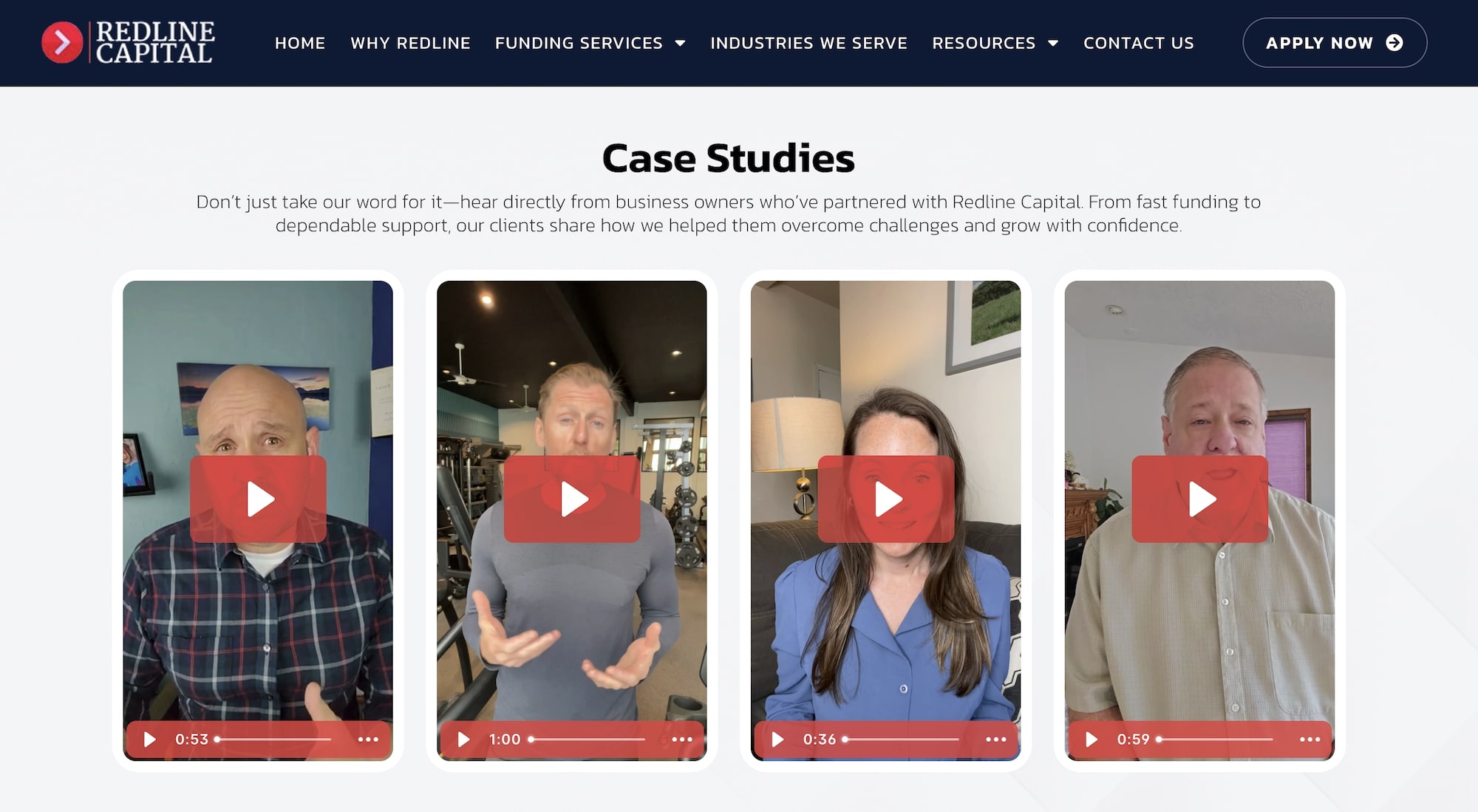
Here’s what business owners say about their experience with Redline Capital:


Visit our case studies page to hear our clients’ experiences with Redline Capital:
Secure Same-day Revenue-based Financing with Redline Capital
Upload four months of bank statements and we’ll email you your financing options. Most clients receive funding the same day they apply.
Revenue-based Financing Alternatives
Bank Loans
Traditional bank loans are the most common type of funding for businesses. You apply through a bank, they evaluate your financial profile, and if approved, they extend a lump sum that you repay with a fixed percentage interest rate.
The main advantage of bank loans is the cost. When you qualify, they offer some of the lowest interest rates available, and repayment terms often stretch several years, keeping monthly payments manageable.
The problem with bank loans is that it’s extremely difficult for most businesses to qualify. Banks scrutinize almost everything: your credit score, years in operation, profit margins, debt-to-income ratio, collateral, personal guarantees, and multiple years of tax returns and financial statements.
Industries like restaurants, retail, and construction face additional hurdles because banks classify them as high-risk regardless of their actual financial performance.
For the businesses that do qualify, banks take 60 to 90 days to fund because of the sheer volume of documentation they must underwrite.
Revenue-based financing solves both problems. Qualification depends on your monthly revenue, not your financial profile, and funding can happen the same day you apply.
Venture Capital
Venture capital involves raising capital from professional investment firms in exchange for equity in your business. For businesses that qualify, the upside is significant because they get a large capital infusion as well as investor expertise and industry connections. Plus, there are no monthly repayments or interest charges, which takes immediate pressure off cash flow.
However, with equity financing, you give up a percentage of ownership and, depending on the terms, a degree of control over major business decisions.
Venture capital firms also have a very specific profile in mind: high-growth businesses with a clear path to a large exit, typically through acquisition or an IPO. Most businesses don’t meet that profile, and those that do often go through months of due diligence, legal structuring, and negotiation before seeing a dollar.
Revenue-based financing offers a different path. You access capital without giving up equity, without investor oversight, and without a three-month process. You stay in full control of your business, and funding is available within hours.
Invoice Factoring
Invoice factoring allows businesses to convert their outstanding invoices into cash by selling them to a factoring company. Instead of waiting 30, 60, or 90 days for clients to pay, you receive a percentage of the invoice value upfront from the factoring company, typically between 70% and 90%.
Because approval is based on your customers’ creditworthiness rather than your own, it can be accessible to businesses with poor credit or limited financial history.
But since the factoring company takes over collections, they communicate directly with your customers, which can create friction or damage relationships if their approach is aggressive.
More importantly, invoice factoring is only available to B2B businesses. If your customers pay at the point of sale, or if you serve consumers directly, the model simply doesn’t apply to you.
Revenue-based financing works for any business with consistent revenue, regardless of whether it’s B2B or B2C. We never contact your customers, and funding is based on your total monthly revenue, not a subset of unpaid invoices.
Read more: Top 7 Fastest Invoice Factoring Companies & How to Choose
SBA Loans
SBA loans are government-backed loans issued through banks and approved lenders, with the Small Business Administration guaranteeing a portion of the loan to reduce lender risk. Because of that government backing, SBA loans often come with lower interest rates and longer repayment terms than traditional debt. This makes them one of the most cost-effective funding options available for businesses that qualify.
However, qualifying is exceptionally difficult. SBA loans come with some of the most demanding eligibility requirements in business lending. This includes strong credit, years of operating history, detailed financial documentation, and in many cases collateral and personal guarantees.
The application and approval process is also notoriously slow, often taking several months from start to funding due to the government review layer added on top of the standard bank underwriting process.
Revenue-based financing only requires that your business meets a minimum monthly revenue threshold, and most applicants are funded within 24 hours.
Merchant Cash Advance
A merchant cash advance is structurally similar to revenue-based financing. You receive a lump sum upfront and repay it as a percentage of your future revenue over time. Qualification is generally easy, and funding can happen quickly, which makes it appealing to businesses that need fast capital and don’t qualify for traditional loans.
Where merchant cash advances fall short is cost and structure. Factor rates on merchant cash advances tend to be significantly higher than those offered by reputable revenue-based financing providers, making them one of the more expensive forms of business loans available. Repayment is also typically tied specifically to daily credit card sales, which can create cash flow pressure on days when card volume is low.
The industry is also less regulated, which has allowed predatory practices to take hold among some providers.
Revenue-based loans, particularly through an established broker like Redline Capital, offer the same speed and accessibility with more transparent terms and lower factor rates.
Read more: 10 Merchant Cash Advance Alternatives & How to Choose
Subscription Financing
Subscription financing is a newer model designed specifically for SaaS companies and startups. Providers advance capital against the value of your annual or multi-year subscription contracts, giving you access to cash now rather than waiting for monthly payments to accumulate.
For SaaS startups, it can be an effective non-dilutive way to smooth out cash flow and fund growth.
The limitation is that it’s a narrow solution. It works only if your business or startup operates on a subscription model with long-term contracts, making it inaccessible to the majority of businesses.
Advance amounts are also constrained by the value of existing contracts rather than your total monthly revenue, which can limit how much capital you can access at a given time.
Revenue-based funding is available to any business with consistent revenue, regardless of whether that revenue comes from subscriptions, one-time sales, service contracts, or anything else.
Frequently Asked Questions
What are the disadvantages of revenue-based financing?
Revenue-based financing is more expensive than traditional financing options like bank loans when measured by total cost. Also, because factor rates are applied to the full amount borrowed, paying off the advance early carries no financial benefit. The total repayment amount is fixed from day one.
How much income do I need for a $500,000 business loan?
The answer depends on the type of financing you’re using. With revenue-based financing, you can qualify for advances of up to 200% of your monthly revenue, meaning a business would need to be generating approximately $250,000 per month to qualify for $500,000. With a traditional bank loan, where advances rarely exceed 50% of monthly revenue, a business would need to show closer to $1,000,000 in monthly revenue.
What is the revenue-based financing process?
The process begins with submitting a few months of bank statements, which are used to verify revenue. The revenue-based financing lender underwrites your application within one or two hours and then presents you offers you qualify for. Once an offer is accepted, the lender deposits funds directly into your business bank account. The entire process takes less than 24 hours.
What does RBF really cost?
The cost of revenue-based financing is determined by the factor rate applied to the advance. For example, a factor rate of 1.1 on a $100,000 advance means you repay $110,000 in total. Depending on your credit history and revenue, factor rates range from 1.1 to 1.4.
What are the benefits of revenue-based financing for startups?
Revenue-based financing offers several advantages for early-stage businesses. Lenders evaluate revenue rather than credit scores, gross margins, or years of operating history, making it accessible to startups that wouldn’t qualify for bank loans. Your startup can also secure financing within 24 hours, compared to the 60 to 90 days traditional financing requires.
How do companies qualify for revenue-based financing?
Qualification requirements vary by provider, but most revenue-based financing lenders have a single requirement: meeting a minimum gross monthly revenue threshold. At Redline Capital, that threshold is $30,000. There are no credit score requirements, no collateral, no demands for years of operating history, and no need to produce tax returns or financial statements.
How does revenue-based financing differ from traditional loans?
Traditional financing evaluates a wide range of factors (e.g., credit scores, profit margins, collateral, years in business, and extensive documentation) and only about 18% of applicants get approved. Revenue-based financing evaluates only monthly revenue, making it significantly more accessible.