


Manufacturers face a cash flow problem that most other small businesses don’t. Cash goes out first for raw materials and labor, then sits in work-in-progress and finished inventory. Even after the sale, customers often pay on net 30, net 60, or net 90 terms. For a small manufacturer, the gap between paying out and getting paid can run 90 days or longer.
A line of credit smooths out that cycle. You draw what you need to buy materials, make payroll, or cover a new production run, pay interest only on what you draw, and the credit becomes available again as customer payments come in.
But despite the benefits of a line of credit, the lender you choose matters because it affects how easy it is to qualify, how fast you get funded, and what you pay in interest and fees.
To help manufacturers get a line of credit quickly and at a low rate, we wrote this guide on what to look for in a lender and how popular lenders compare.
Find out what your manufacturing business qualifies for (rates, terms, borrowing limits) in minutes with our instant loan pricer. When you’re ready, submit four months of bank statements, and you’ll have the option to close as quickly as the same day or the next.
| Lender | Minimum credit score | Time in business | Funding speed | Max line |
| Redline Capital | None | 12 months | Same day or the next | $750,000, or 200% of monthly revenue |
| Loot | None | 1 year | Same business day possible | $100,000 |
| Bluevine | 625 | 12 months | Decision in as little as 5 minutes, funds in hours to the next business day | $250,000 |
| OnDeck | 625 | 1 year | Repeat draws can be instant | $100,000 |
| Rapid Finance | Not published (reviews cite 550) | 24 months | Same day to 3 business days | About $250,000 |
| SBA 7(a) MARC | Set by the SBA lender | Set by the SBA lender | Weeks to months | $5 million |
| Celtic Capital | Unconfirmed | Established operations | Weeks | $8 million (A/R + inventory + equipment) |
| Credibly | 675 | Not published (no startups) | Approval in as little as 2 hours | $600,000 |
| Kapitus | 650 | 2 years | Decision in about 4 hours, funds as soon as the next day | $250,000 |
| Live Oak Bank | Varies by product | Varies by product | Expedited process for requests under $500,000 | $5 million (SBA 7(a)), $25 million (conventional) |
Factors to Consider When Choosing a Line of Credit for Your Manufacturing Business
What are the lender’s requirements?
Many line of credit lenders have extremely high, sometimes unrealistic requirements, asking for near-perfect personal credit, several years in business, personal guarantees, healthy cash flow, low debt-to-income ratios, and more. Due to this, only about 13% of businesses that apply at banks get approved.
Manufacturers often have the extra problem of looking weak on the metrics banks care about. Margins are tight, cash sits in inventory and work-in-progress for weeks, and bank statements can look lumpy because of large order deposits and net 60 or net 90 receivables. A business with $5 million in equipment, inventory, and AR on paper can still get rejected because the cash flow doesn’t fit a traditional underwriting template.
What’s worse, businesses typically don’t learn they’ve been rejected until weeks into the application, and by then they’ve lost time they could have spent applying elsewhere.
So check a lender’s criteria before you commit. One with more realistic requirements gives you a fair shot at qualifying from the start.
How much paperwork does the lender require?
Many lenders promise fast business funding on their homepage, but from what we hear from borrowers, few can actually deliver. Lenders will promise to close in a day or two, and when you fast-forward a few weeks later, the money still hasn’t arrived in your account.
If speed matters to you, we recommend not taking a lender’s advertising claims at face value. Check how much paperwork they ask for, since that’s a better indication of how quickly they’ll actually fund.
Every document you have to submit is something the lender has to evaluate and underwrite. Manufacturers often get asked for current and prior-year tax returns, year-to-date financials, AR aging reports, inventory counts, equipment lists, and customer concentration summaries on top of the usual stack. The longer the list, the longer you can expect to wait for your funds.
Does the lender pressure you to sign?
Pressure is one of the clearest signs of a bad offer. A lender with a good rate doesn’t need to hurry you, because it knows the numbers hold up next to anyone else’s.
Lenders with expensive, sometimes predatory offers often pressure you to sign right away, before you have a chance to see what other lenders would offer. Some even use false urgency, such as claiming another business wants the funds or that the offer expires tonight.
The less pressure a lender puts on you to accept, the more likely the offer is a competitive one.
What will the line actually cost?
Cost varies more between lender types than most borrowers expect. Here’s a rough map, with the understanding that your actual rate depends on your credit, revenue, and the specific lender’s offer:
- Bank lines of credit, including SBA MARC loans, typically price at prime plus 2% to prime plus 6%, which works out to roughly 10% to 15% APR as of 2026. Lowest cost, but also the slowest to close and the hardest to qualify for.
- Asset-based lines of credit from specialists like Celtic Capital usually fall in a similar range on the headline rate, with monitoring and audit fees that add 1% to 2% to the effective cost.
- Online lenders typically price in the 30% to 70% APR range depending on your credit profile and term, plus draw fees at some lenders. Bankrate puts OnDeck’s current average LOC APR around 57%, which is representative of the tier.
- Revenue-based lenders such as Redline Capital quote factor rates rather than APR, with effective APRs typically in the 20% to 50% range depending on your revenue and term.
Speed and accessibility come at a cost. Whether that cost is worth paying depends on what the money unlocks. A $100,000 order you’d otherwise lose is worth paying a higher rate for 60 days. Covering last month’s rent gap usually isn’t.
Does the lender understand how manufacturers get paid?
Lenders who don’t know manufacturing can mistake normal patterns for warning signs.
It’s normal for revenue to arrive in lumps when a big order ships, for most of the revenue to come from two to five large customers, for receivables to sit at net 60 or net 90, and for a slow season to look like a cash flow problem on paper. Custom and contract manufacturers also take deposits and progress payments, which look like irregular revenue to an underwriter unfamiliar with the industry.
Yet, an underwriter who doesn’t recognize this can read it as unstable income, customer concentration risk, or weak cash flow, which can lead to a higher rate or an outright rejection.
Go with a lender that has worked with manufacturers. They understand how production and payment cycles work and won’t penalize you for what’s standard in your industry.
What assets can you borrow against?
Manufacturers have real collateral most other small businesses don’t, including raw materials, finished inventory, equipment, and accounts receivable. Those assets matter because they open up a tier of lending most other businesses can’t access.
Asset-based lenders will extend much larger lines (into the millions) secured by your AR and inventory, with advance rates typically around 85% of eligible receivables. Revenue-based and online lenders won’t ask for them, but their caps are usually lower, often $100,000 to $750,000.
Knowing which asset base you can lean on, and whether you’d rather avoid pledging it, decides which tier of lender fits your business.
5 Line of Credit Lenders Compared to the Factors Above
1. Redline Capital: Same-Day Lines of Credit Approved Based on Your Revenue
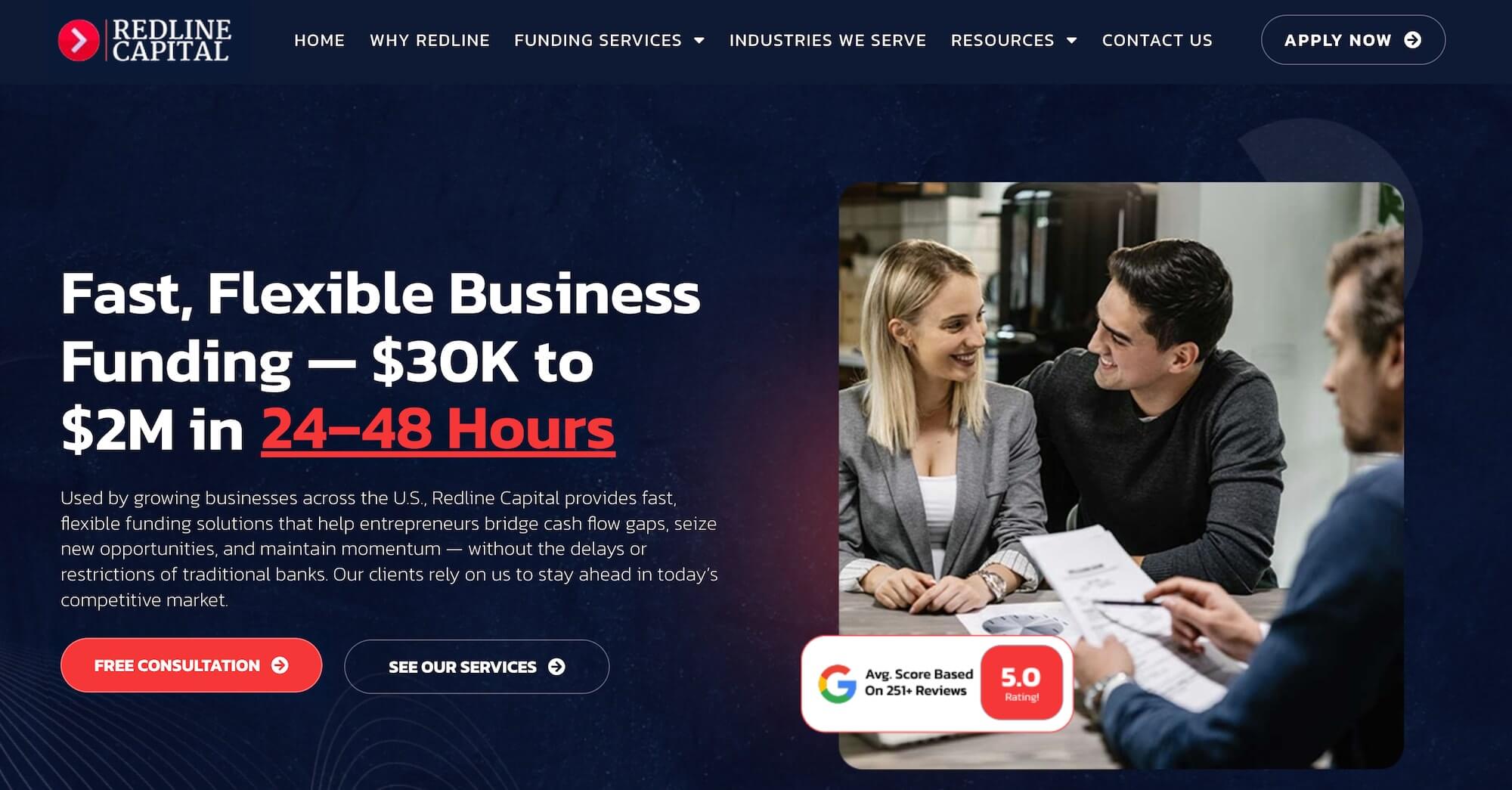
We built Redline because we saw how big banks work. They were slow, buried in paperwork and bureaucracy, and set requirements so strict that most businesses couldn’t qualify.
At Redline Capital, our aim is to make business financing faster and more accessible. Over several years, we’ve helped countless manufacturers (that banks turned away) secure lines of credit, totaling hundreds of millions of dollars.
Who Redline Fits Best
Redline is a strong fit if your business brings in $30,000 or more a month; you’ve been operating for at least 12 months; you’ve been turned down by a bank or don’t want to spend weeks on an SBA application; and you need funds within a day or two to catch an order or buy materials.
We’re less of a fit for an established manufacturer with $5 million or more in annual revenue and strong AR, because Celtic Capital will offer a larger line at a lower rate, or the SBA MARC program will go lower still if you can wait weeks for underwriting. We’re also not the right choice for pure equipment purchases, where dedicated equipment financing is cheaper.
If the first description sounds like your business, here’s how we work.
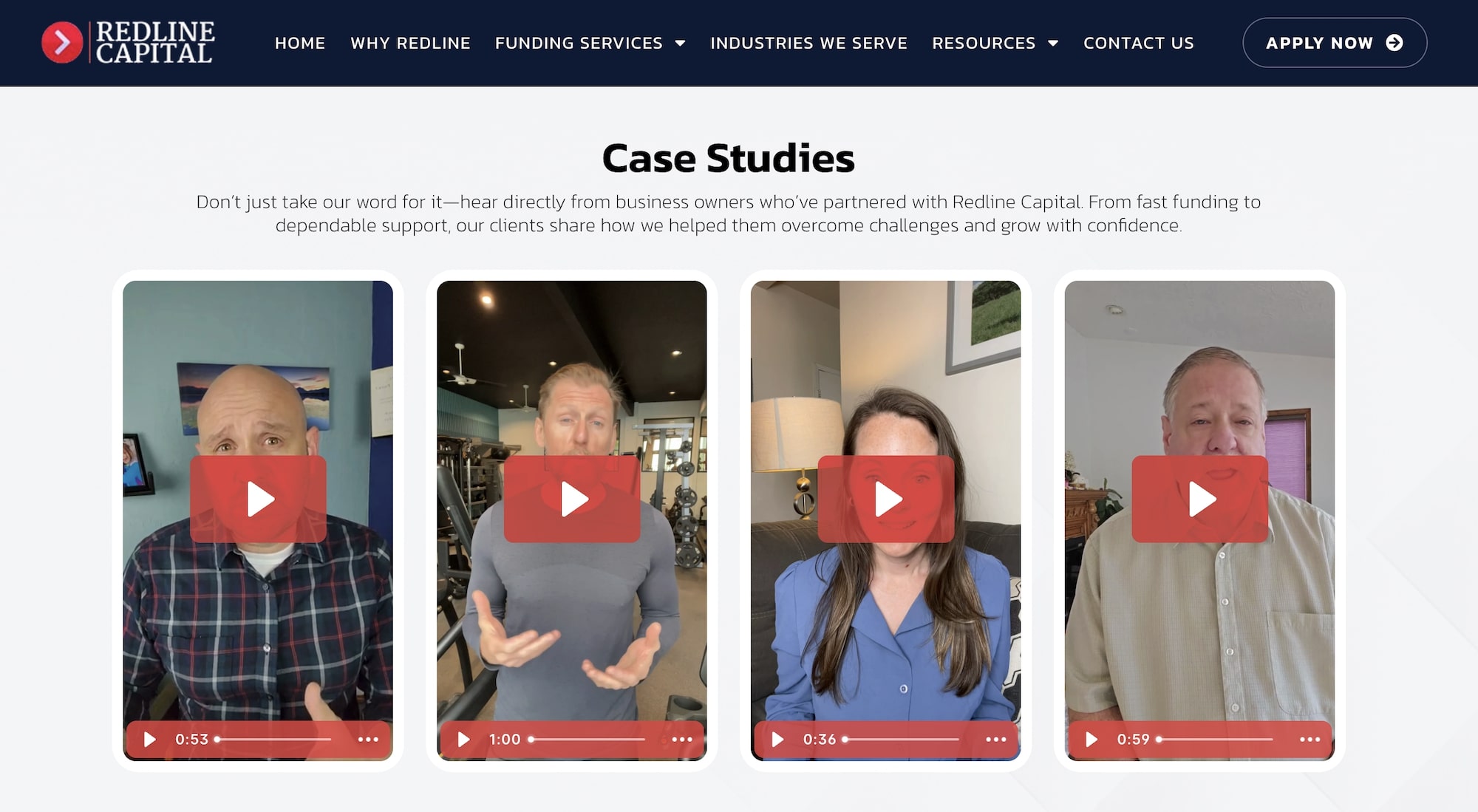
Hear directly from our borrowers:


Visit our case studies page to watch borrowers talk about their experience with Redline Capital:
We Only Have Three Requirements and Approve Over 80% of Businesses
We designed our requirements for businesses that banks and other financial institutions turn away. Instead of judging your credit history and entire financial profile, we check that your business brings in enough revenue and has been operating long enough.
To qualify, you need:
- $30,000 or more in monthly revenue
- At least 12 months in operation
- A U.S.-based business
We don’t ask for a strong credit history, a minimum profit margin, or collateral.
Because our requirements are so accessible, more than 80% of the businesses that apply with us get approved.
Four Months of Bank Statements Is All We Need and We Can Close the Same Day or the Next
As we mentioned earlier, a good way to judge how fast a lender will really move is to look at how many documents it asks you to submit.
At Redline Capital, we deliberately keep our paperwork requirements minimal.
To confirm that your business brings in $30,000 or more each month, we ask for four months of bank statements. That’s all. We don’t need tax returns, financial statements, AR aging, inventory counts, or collateral.
As a result, we can close most lines of credit the same day you apply or the next.
We Never Pressure You Into Accepting Because We Offer Competitive Rates
We don’t push anyone to sign because we’re confident our offers are strong enough on their own, and most borrowers who look at other options end up coming back to us.
That’s because for more than a decade, we’ve worked as a broker with top lenders (e.g., OnDeck, Rapid Finance, Headway Capital), and the borrowers we’ve sent them have helped grow their lending businesses.
In exchange, those lenders give us better rates and terms than they offer to businesses that approach them directly, and we pass those terms on to you, which is how we’re able to offer industry-leading rates.
We Know Manufacturers, So We Won’t Penalize You for What’s Normal in Your Industry
We’ve worked with manufacturers for several years, so we know the challenges they face across the industry.
That means we don’t mistake lumpy revenue from large orders for unstable income, we don’t flag two or three big customers as concentration risk, and we don’t read a net 60 receivable as a cash flow problem. Your application is far less likely to be rejected or to come back with an excessive interest rate.
You Can Use Our Lines of Credit for Whatever Your Business Needs
Our lines of credit aren’t tied to a specific purpose, so you can use them for anything your manufacturing business needs. Some common examples include:
- Raw material purchases ahead of a production run
- Production payroll across build cycles
- Tooling, dies, and setup costs for a new product line
- Equipment repairs and rental replacements during downtime
- Bridging net 30 or net 60 customer payment schedules
- Taking on a larger order without draining existing production
- Trade shows, catalogs, and sales samples
- Freight, shipping, and import duties
- ERP, MRP, or quality management software
A Few Things to Watch Out For
A line of credit is a flexible tool, but it’s one manufacturers can get wrong in specific ways. A few things to watch for, regardless of which lender you end up with:
- Don’t draw to cover a loss. A line of credit is for cash flow gaps, not structural losses. If your business is losing money every month, a line of credit postpones the problem rather than solving it, and makes it worse by adding interest.
- Don’t draw against an order that isn’t signed. Only draw once the purchase order is confirmed and the deposit, if any, is in hand. If you draw to buy materials for an order that falls through, you still owe the balance and you’re sitting on inventory you can’t move.
- Match the draw to the payment cycle. If your customer pays on net 60, structure the draw so you can repay around day 60 or 70. Stacking a new draw before the previous one is repaid can push you into a payment schedule your cash flow can’t support.
- Watch customer concentration. If 60% of your revenue comes from one customer, confirm the order and payment terms before funding their production run with a line of credit. Losing that customer mid-run turns a line of credit into a long-term problem.
- Keep some headroom. Try not to run the line at 95% utilization. Keeping 20% to 30% available means you have something left for a real emergency (equipment failure, surprise tax bill) rather than being fully drawn when it hits.
Read more:How to Use a Business Line of Credit: Smart Uses & Mistakes
2. Loot
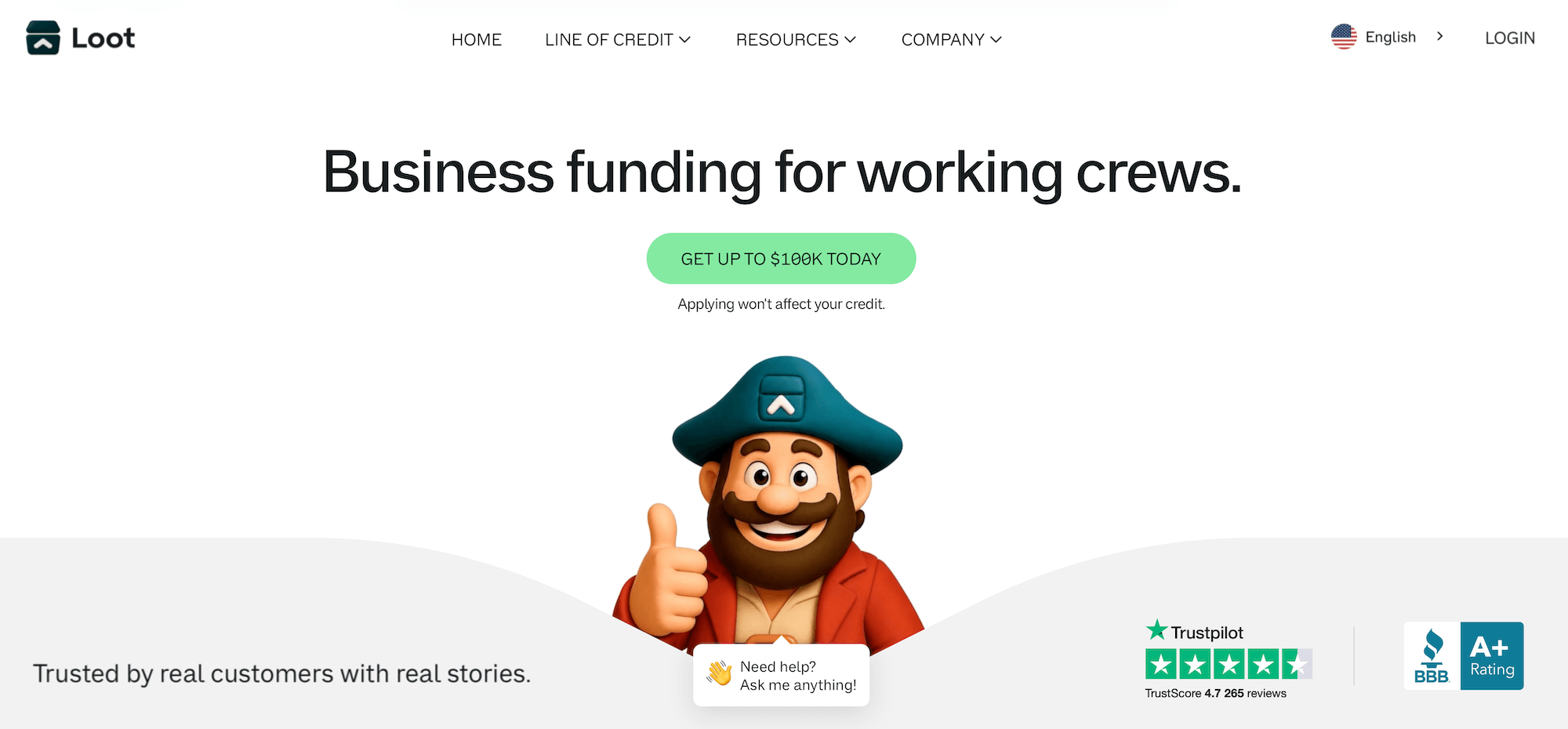
Founded in Boston in 2021, Loot is a direct lender that funds a revolving line of credit, with a page written specifically for manufacturers and fabricators. The page covers custom and made-to-order manufacturers, metal and wood fabrication shops, small-batch and contract manufacturers, and growing shops taking on bigger contracts.
Loot’s manufacturing line of credit runs from $5,000 to $100,000. Requests up to $30,000 get an instant decision, with larger requests taking a few more minutes. Approved businesses can get funds the same business day for a $49 transfer fee, with no collateral required.
To qualify, Loot asks for at least one year in business and $200,000 in annual revenue, with no minimum credit score. It uses only soft credit inquiries, so applying doesn’t affect your personal credit.
That $200,000 revenue minimum leaves out the smallest shops, and the $100,000 borrowing limit can fall short for a manufacturer buying raw materials in bulk or covering payroll across a long build cycle. Because Loot funds only a line of credit, there is also no term loan or equipment financing product if your plans change.
3. Bluevine

Bluevine is an alternative lender that has delivered more than $16 billion in working capital to over 900,000 U.S. businesses, and it has published a 2026 guide on how manufacturers use lines of credit for raw materials, seasonal ramp-ups, bridging supplier payment terms, and funding tooling or prototype work. Its line of credit goes up to $250,000, and a decision can come back in as little as five minutes.
Each draw has its own repayment timeline, and Bluevine reports your repayment history to Experian. That can help a manufacturer build business credit over time.
To qualify, Bluevine generally asks for a personal credit score of 625 or higher, at least 12 months in business, and $10,000 or more in monthly revenue. A single application also checks you for loan offers from its partner lenders.
Repayment terms run 6 to 12 months, making each payment larger than it would be on a longer schedule, which can be a problem for a manufacturer whose large customer payments arrive on net 60 or net 90 terms. Bluevine also requires a personal guarantee, and the effective APR can run well above the headline rate once fees and the repayment structure are included.
4. OnDeck

OnDeck began lending to small businesses in 2007 and has delivered more than $15 billion. Its line of credit runs from $6,000 to $100,000 with 12-, 18-, or 24-month repayment terms. Repeat draws can be made instantly with a debit card, and it carries no draw fees or maintenance fees.
To qualify, a business needs at least one year in business, a personal credit score of 625 or higher, and $100,000 in annual revenue.
OnDeck lends to more than 700 industries and doesn’t list manufacturing as restricted, though it does not lend in Nevada, North Dakota, or South Dakota. OnDeck also reports your payment activity to the business credit bureaus, which can help a growing manufacturer build business credit over time.
The headline cost is high. Bankrate puts OnDeck’s average LOC APR at around 57% as of early 2025, so this is a speed-and-access product rather than a low-cost one. Because OnDeck lends directly, you also get one lender’s view of your business instead of offers from several.
OnDeck is one of the lenders in Redline Capital’s network. Applying through us may get your business a better rate than applying directly because of the business volume we’ve sent OnDeck over the years.
5. Rapid Finance

Based in Bethesda, Maryland, Rapid Finance has lent to U.S. businesses since 2005 and carries a line of credit alongside term loans, SBA loans, and merchant cash advances. That broader menu is useful for a manufacturer who might also want equipment financing or an SBA loan program down the road. Its line of credit goes up to about $250,000, and funding on most products takes anywhere from the same day to three business days.
For its line of credit, NerdWallet reports a minimum of 24 months in business and $150,000 in annual revenue, along with automatic repayments from a business bank account. Some reviews list minimum credit scores as low as 550.
That two-year minimum rules out newer manufacturers, and the automatic repayments take a set amount from your account on a fixed schedule, which can strain cash flow in a slow production month or when a big customer is late paying. Rapid Finance also uses a hard credit pull, so checking your options leaves a mark on your credit report.
Rapid Finance works with Redline Capital as a lending partner. Applying through us may get your business better pricing than applying directly, based on the volume of business we’ve sent them over the years.
6. SBA 7(a) MARC Line of Credit
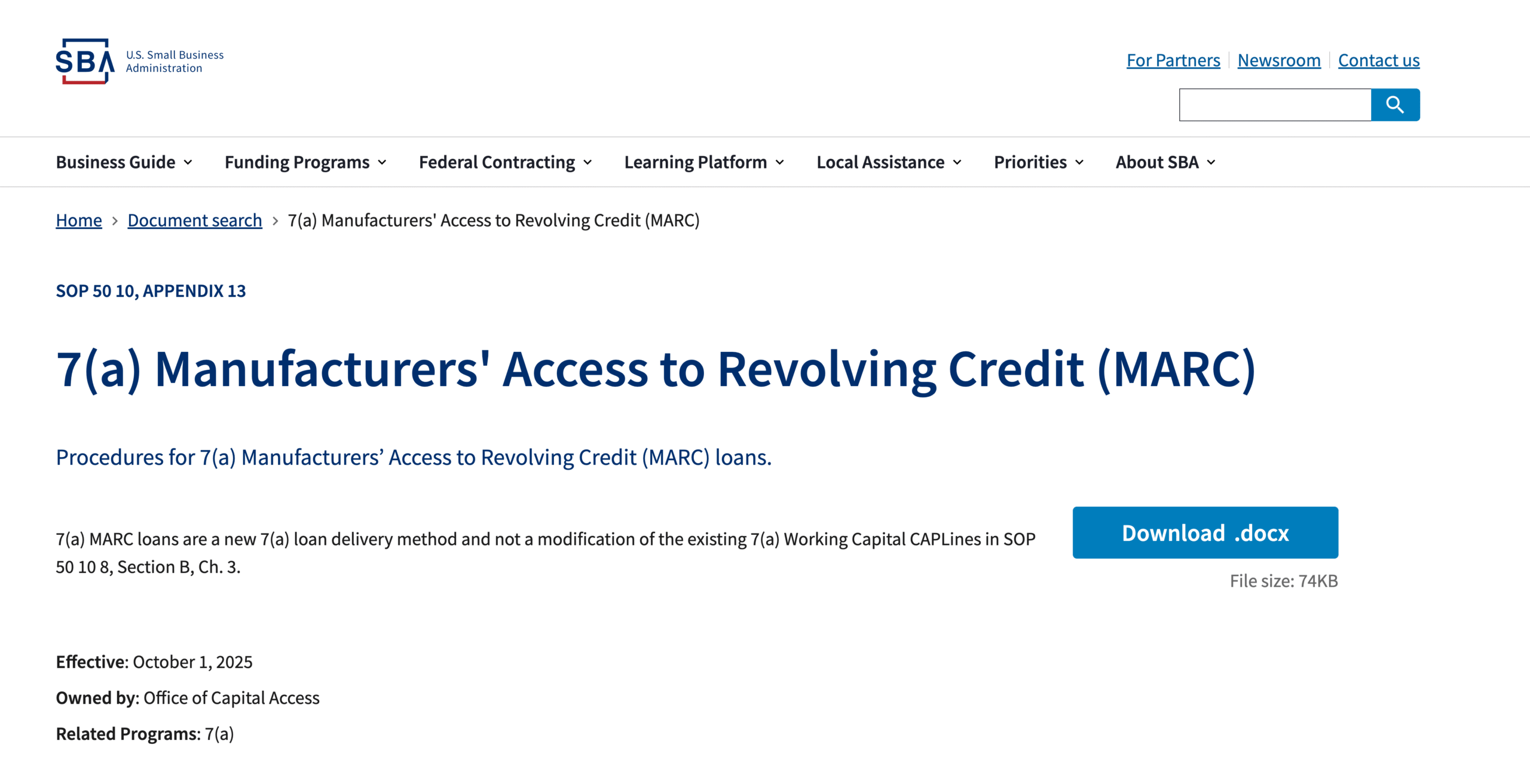
The SBA launched the Manufacturers’ Access to Revolving Credit (MARC) program on October 1, 2025, as its first-ever 7(a) product designed specifically for manufacturers. MARC loans can be structured as either a revolving line of credit (up to 20 years) or a term loan (up to 10 years), with a maximum loan amount of $5 million. Eligibility is restricted to small businesses engaged in manufacturing under NAICS codes 31, 32, or 33, which cover food processing, textiles, metal fabrication, machinery, electronics, breweries and distilleries, commercial printing, and most other manufacturing categories.
You apply through an approved SBA 7(a) lender rather than directly through the SBA. The federal guarantee covers up to 85% on loans of $150,000 or less and 75% on larger loans, which gives lenders room to extend credit they wouldn’t otherwise approve. Rates are negotiated between the lender and borrower within SBA caps, so a MARC line of credit is typically cheaper than any non-bank option on this list. Through September 30, 2026, the SBA is also waiving most upfront fees on manufacturing 7(a) loans of $950,000 or less.
A few things to know about the fine print. MARC loans are underwritten like a standard SBA 7(a) loan, so expect full business and personal tax returns, financial statements, projections, and a detailed use-of-funds narrative. Proceeds can only be used for working capital, not for debt refinancing, ownership changes, or paying delinquent taxes. On revolving structures, your trading assets (AR and inventory) must be pledged as collateral, and the lender must conduct annual financial reviews. If you miss cash flow, collateral, or compliance targets, the lender is required to convert the line into a fully amortizing term loan.
Expect weeks to months from application to funding, depending on the lender and your preparation. MARC is the right fit for an established manufacturer that can afford to wait and wants the lowest rate available. It isn’t a fit if you need materials money this week.
7. Celtic Capital

Founded in 1983 and based in Calabasas, California, Celtic Capital is an asset-based lender that specializes in manufacturers, wholesalers, distributors, and service providers. Its published deal history is dominated by precision metal shops, food manufacturers, plastics and rubber extrusion operations, truss manufacturers, lighting fixture makers, and other job-shop producers.
Celtic extends asset-based financing from $500,000 to $8 million, typically combining an accounts receivableline of credit (advancing around 85% of eligible receivables) with an inventory line and an equipment loan when the borrower needs them. The company partners with specialist inventory lenders like Crossroads Financial when a borrower needs more inventory availability than Celtic alone can provide.
Celtic underwrites on the quality of your AR book and the composition of your inventory, not on your credit score or cash flow margins. And because it focuses on collateral quality, Celtic doesn’t require financial covenants, which can matter for a manufacturer whose numbers swing with the production cycle. Celtic’s own published deal history shows multiple manufacturers who came to the company after their bank asked them to leave over a covenant violation.
The structure comes with the trade-offs you’d expect from asset-based lending. The $500,000 floor rules out smaller shops, and borrowers can expect monthly borrowing base reporting, periodic field exams, lockbox arrangements for AR, and weeks from engagement to closing. Celtic is the right fit for a manufacturer with $5 million or more in annual revenue and $500,000+ in receivables to borrow against. Smaller manufacturers would be better served by a revenue-based or online lender on this list.
8. Credibly
Credibly was founded in 2010 as RetailCapital and is headquartered in Southfield, Michigan, with additional offices in New York and Arizona.
Its line of credit goes up to $600,000, comes as a secured or unsecured product, and can be repaid through weekly or monthly loan payments, with approval possible in as little as two hours. The higher cap matters for a manufacturer whose working capital needs exceed what OnDeck, Loot, or Headway will extend, without jumping to the asset-based tier.
To qualify, Credibly generally asks for a personal credit score of at least 675 and $20,000 in monthly revenue. Credibly uses soft credit checks so checking your options doesn’t affect your credit score.
That 675 credit score minimum is higher than most lenders in this comparison, so manufacturers with fair credit may not qualify. Credibly also doesn’t finance startups, so a newer manufacturer without an operating history may not qualify either.
9. Kapitus

Kapitus, founded in 2006 as Strategic Funding Source, is a direct lender that sells a line of credit alongside a broader range of financing options, including term loans, equipment financing, and invoice factoring. That broader menu can be useful for a manufacturer who wants one lender for working capital, equipment, and AR financing instead of shopping each product separately.
Decisions can come back in about four hours, funds can arrive as soon as the next day, and its KapitusPLUS process can bring back offers from several lending partners side by side.
Kapitus generally asks for a credit score of at least 650, two years in business, and about $250,000 in annual revenue for its line of credit. Its first check uses a soft credit pull, so comparing offers doesn’t affect your score.
A business that clears two of the three thresholds still won’t qualify, so newer or smaller manufacturers with steady revenue are usually left out. Larger manufacturers with stronger credit are a better fit.
10. Live Oak Bank

Live Oak Bank, a North Carolina-chartered bank founded in 2008, ranked as the country’s most active SBA 7(a) lender by dollar volume for fiscal year 2025, with $2.8 billion in approved loans.
Live Oak lends to manufacturers across SBA and conventional products, with loan amounts running from $10,000 on Express loans to $5 million on SBA 7(a) loans and $25 million on conventional loans. An expedited loan process covers requests under $500,000. Financing options for manufacturers cover acquisition, expansion, equipment, real estate, and refinancing.
Qualifying depends on the product, and SBA 7(a) loans follow SBA eligibility rules. SBA loans carry no covenants, while conventional loans do.
Live Oak structures most of its manufacturing loans to be aimed at buying a facility or equipment, not at covering the gap between materials costs and customer payments, so they don’t replace a line of credit. They also come with a fixed repayment schedule, which means the same payment is due each month whether or not a big customer has paid you yet. If your working capital need is recurring rather than one-off, pair it with a true line of credit from one of the earlier lenders on this list.