


Manufacturers commonly extend long payment terms to their customers to secure deals and incentivize larger orders. They will often allow customers to pay 30, 60, or 90 days after the delivery date.
However, this payment delay often means manufacturers must cover raw materials, supplier payments, payroll, and equipment costs upfront, among other financial obligations, which can strain cash flow and working capital.
That’s why many manufacturers turn to invoice factoring.
In this article, we cover how invoice factoring works, the advantages and disadvantages for manufacturers, what you need to qualify, and how to apply.
We also cover Redline Capital’s financing options for manufacturers and how we can help you get funded the same day with just 4 months of bank statements.
Submit four months of bank statements and receive financing offers the same day. Our application takes less than five minutes and will not affect your credit score.
What Is Manufacturing Invoice Factoring?
Manufacturing invoice factoring is a financing solution that allows manufacturers to access immediate working capital by selling their outstanding invoices to a third-party company.
The factoring company pays you 70% to 90% of the invoice’s value upfront, and the rest once your customers pay, minus a 1% to 5% factoring fee.
That way, once you invoice customers, you don’t have to wait 30, 60, or 90 days for them to pay. You get a cash advance within days from the factoring company, use it to purchase raw materials, pay suppliers, and cover payroll for your next production run, and they collect customer payments.
Advantages of Invoice Factoring for Manufacturers
- Immediate access to working capital: Instead of waiting 30 to 90 days for customers to pay, invoice factoring converts your outstanding invoices into cash within days of delivery.
- Extend competitive payment terms without straining cash flow: You can offer long payment terms, knowing you can convert receivables into cash immediately after delivery.
- Does not add debt to your balance sheet: Because you aren’t borrowing money, invoice factoring does not appear as debt. This is particularly useful for manufacturers with high debt-to-income ratios who may not qualify for a traditional loan.
- Take on new orders without waiting for existing ones to settle: Once you deliver and issue an invoice, you can factor it immediately and use that immediate cash flow to fund your next production run. You can accept more orders and grow faster than your cash flow would otherwise allow.
Disadvantages of Traditional Invoice Factoring for Manufacturers
Despite the benefits, traditional invoice factoring comes with limitations worth understanding before committing to it as a financing solution:
- Qualifying is hit-or-miss and largely outside your control: Approval depends on your customers’ credit, not yours, so a single customer with a weak balance sheet or repayment record can get your application rejected regardless of how strong your own business is.
- Slow funding due to paperwork: Invoice factoring is faster than a bank loan, but same-day or next-day funding is rarely achievable. That’s because the factoring company has to evaluate your documents, your customers’ credit, and your invoices. In many cases, funding can take up to four weeks.
- Risk to client relationships: Because the factoring company purchases your invoices and collects payment directly from your customers, you lose control of that relationship. Some factoring companies use aggressive collection tactics that can damage client relationships.
- Smaller funding amounts: Invoice factoring typically advances only 70% to 90% of an invoice’s value. This may not be enough to pay for large orders or production runs.
- You need existing invoices to qualify: Invoice factoring only works after you have delivered goods and issued an invoice. If you need capital to fund a large incoming order, you cannot factor an invoice that does not yet exist.
Later on, we’ll cover how Redline Capital addresses these four limitations.
Requirements for Manufacturing Financing
Requirements will vary from company to company, but you’ll typically need (1) established invoices and (2) customers with strong credit scores and repayment histories.
As a result, qualifying for invoice financing can be hit-or-miss and is outside your control. You can do everything right, have strong revenue, clean books, and years in business, and still get rejected because one of your customers has a shaky balance sheet.
At Redline Capital, we take a slightly different approach. Instead of evaluating your clients’ credit history and financial health, we look at your monthly revenue, so you only need to meet our revenue threshold of $30,000 per month to qualify.
Our simple qualification criteria offer the following benefits:
- Easy qualification: Over 80% of manufacturers that apply with us qualify.
- Same-day funding: We only need four months of bank statements proving your revenue, so most manufacturers receive funds the same day they apply.
- No risk to client relationships: We never purchase your invoices or contact your customers. Your collection process stays entirely in your hands.
- Up to 200% of your monthly revenue: Rather than advancing 70% to 90% of a single invoice, we advance up to 200% of your monthly revenue, giving you significantly more working capital.
- No invoices needed: Because we advance against your monthly revenue rather than outstanding invoices, you can access capital before you deliver goods. This makes it a far better fit for manufacturers who need to fund production upfront.
Read more: Why Use Revenue-Based Financing Instead of Debt Financing?
How to Apply for Manufacturing Financing
Applying for traditional invoice factoring is a multi-step process that can take two to four weeks from start to funding.
You need to gather and submit outstanding invoices, AR aging reports, client contracts, and proof of delivered work, among other documents.
The factoring company then runs credit checks on each of your customers, since approval depends on their ability to pay. If you want to compare advance rates across multiple factoring companies, you repeat this process for each one.
Once approved, you receive 70% to 90% of the invoice amount upfront, and the rest once your customers pay.
On the other hand, applying for manufacturing financing with Redline Capital takes less than five minutes and requires none of that paperwork, enabling you to get funded on the same day you apply:
- Upload four months of bank statements showing your revenue. No AR aging reports, client contracts, tax returns, or proof of completed work required.
- We email you multiple financing offers within a few hours. Because we underwrite your revenue rather than your customers’ creditworthiness, we can complete underwriting the same day you apply. Funding options include lines of credit, term loans, working capital business loans, and equipment financing.
- You review offers and select the one that fits your business. Every offer breaks down the financing amount, the total repayment amount, the repayment timeline, and the payment frequency.
- Funds are deposited into your bank account within hours of accepting an offer. The entire process typically takes under 24 hours. For manufacturers who needed funds faster, we have funded them within 4 hours.
Why Choose Redline Capital for Manufacturing Financing
We’ve worked with manufacturing businesses across a wide range of sectors, including food and beverage, auto parts, electronics, medical equipment, and more.
Here’s what sets our cash flow solutions apart from other options.
We Help You Secure the Most Competitive Terms Available
Redline Capital is a financing broker with decade-long relationships with top business lenders, including OnDeck, Rapid Finance, and Headway Capital. We have delivered hundreds of millions of dollars in high-quality applications to these lenders, and in return, they offer us preferred pricing, wholesale rates, exclusive discounts, and higher credit limits.
By applying through Redline Capital, you gain access to exclusive rates and favorable terms unavailable to direct applicants, ensuring you receive the best possible offers.
Our strong lender relationships also empower us to negotiate on your behalf. Even if your application is borderline, we can often persuade lenders to approve it, increasing your chances of securing funding.
Essentially, applying with us means you tap into all the business we sent our lending partners over the years to get better rates.
In addition to better rates, working with a broker like Redline Capital offers the following advantages:
- Less paperwork: A broker lets you fill out one application to see options from multiple lenders, instead of separate, lengthy applications for each. Direct lenders also tend to require more paperwork than brokers do, making each solo application even more time-consuming.
- Faster funding: Brokers typically get quicker responses from lenders because they have established relationships and bring in a steady stream of qualified business. This can mean the difference between securing funding in hours rather than days.
We Have Deep Expertise in the Manufacturing Industry
We understand that manufacturing businesses have financial characteristics that less-experienced lenders often misread. Seasonal revenue fluctuations, long payment cycles, and high upfront production costs are standard in manufacturing.
But many lenders view them as problems with your business and may reject your application because of it.
Due to our experience working with manufacturers, we can accurately evaluate your business. We don’t penalize you with higher rates for having cash flow challenges, slow-paying customers, or the normal cycles of a manufacturing business.
Read more: Top 7 Fastest Invoice Factoring Companies & How to Choose
We Never Pressure You to Accept an Offer
Many low-quality factoring companies will phone and email you nonstop as soon as you submit an application, trying to rush you into a decision.
Some will invent urgency, such as expiring offers, rising rates, or competing borrowers, to rush you into accepting terms (often filled with hidden fees) before you have had a chance to think.
At Redline Capital, we take the opposite approach. When you apply, we email you the offers you qualify for and give you all the time you need to review them. We want you to understand exactly what you are getting into (the rate, the fees, the payment schedule, and how the terms fit with your cash flow needs) before making any decision.
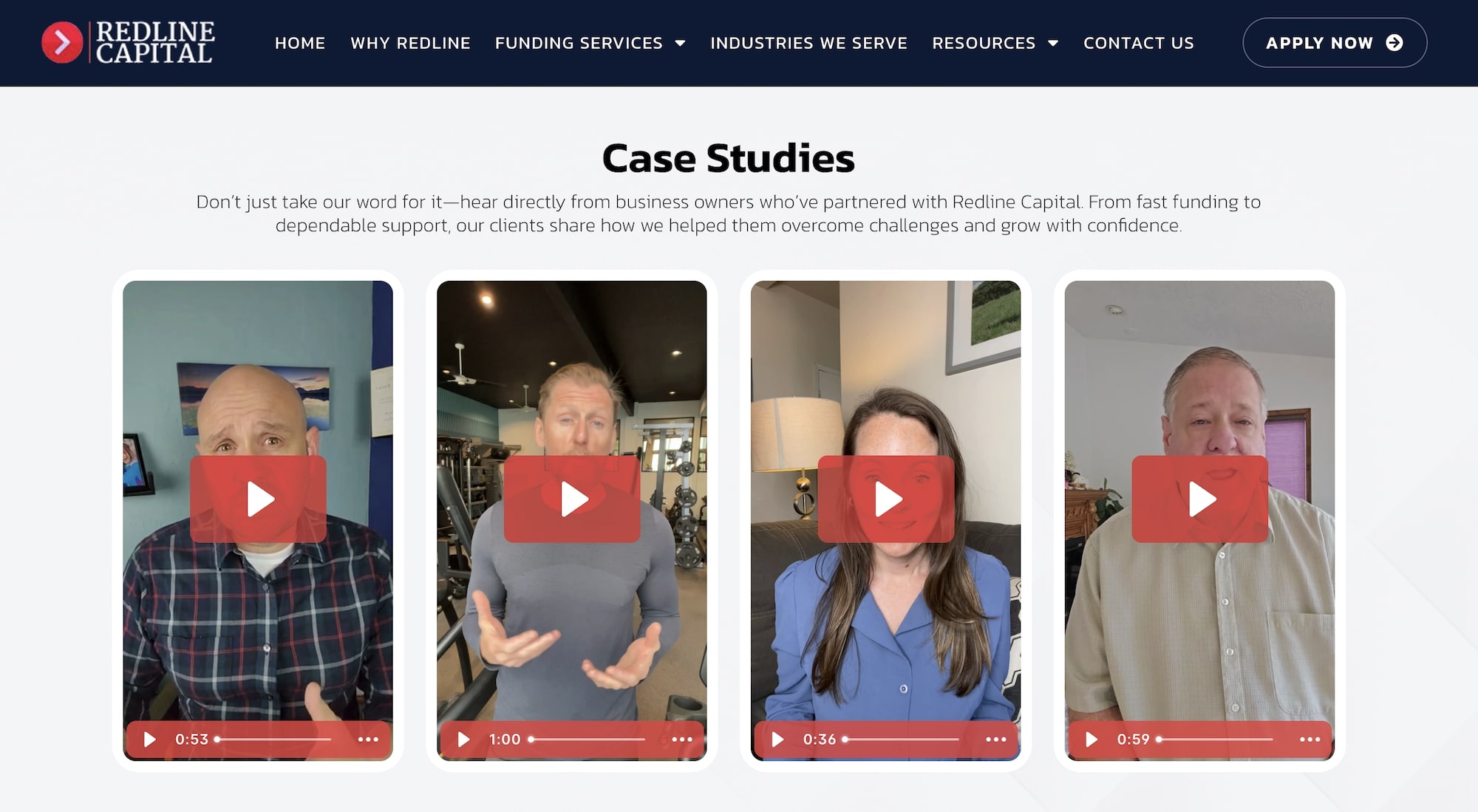
Here’s what business owners who’ve partnered with us say about our factoring services:


Visit our case studies page to hear directly from our clients:
Secure Same Day Manufacturing Financing with Redline Capital
Submit four months of bank statements and receive financing offers the same day. Our application takes less than five minutes and will not affect your credit score.
FAQs
What is the average cost of invoice factoring?
Factoring fees typically range from 1% to 5% of the invoice value per month, depending on invoice volume, your customers’ creditworthiness, and the factoring company. Fees compound the longer your customers take to pay, so slow-paying clients can make factoring significantly more expensive than it initially appears.
What is manufacturing invoice factoring?
Manufacturing invoice factoring is a financing arrangement where manufacturers sell their outstanding invoices to a third party at a discount in exchange for immediate cash. It helps bridge the cash flow gap between completing production and waiting for customers to pay on net 30 to 90-day terms.
What percentage do factoring companies take?
Factoring companies typically charge between 1% and 5% of the invoice value. Most charge a flat fee per 30-day period, meaning the longer a customer takes to pay, the more the factoring costs. High-volume manufacturers with creditworthy customers tend to qualify for advance rates at the lower end.
How does invoice financing for manufacturers work?
A manufacturer completes an order and issues an invoice. Rather than waiting for payment, they sell that invoice to a factoring company, receive 70% to 90% of its value upfront, and the factoring company collects from the customer. The remaining balance, minus fees, is released once payment clears.
How can a manufacturing company qualify for invoice factoring?
Qualification depends primarily on your customers’ creditworthiness rather than yours. Factoring companies evaluate who owes you money, not your business financials. You generally need legitimate, verifiable invoices from creditworthy commercial customers. This makes it hit or miss if your client base includes small businesses with weak or limited repayment histories.
Is accounts receivable factoring a loan?
Factoring isn’t considered a business loan because it’s simply the sale of your invoice. You are not borrowing against the invoice; you are selling it at a discount. This means no debt on your balance sheet, but it also means you lose a percentage of the invoice value permanently.
How does invoice factoring benefit manufacturing businesses?
Factoring gives manufacturers immediate access to cash tied up in unpaid invoices, allowing them to cover payroll, purchase materials, and take on new orders without waiting 30 to 90 days for payment. It is faster to set up than a bank loan and does not require collateral.
What are the risks associated with manufacturing invoice factoring?
The factoring company contacts your customers directly to collect payment, which can strain client relationships. Qualification depends on your customers’ credit, not yours, making it unreliable with weaker clients. Fees compound over time, and some contracts include long-term commitments or minimum volume requirements that limit flexibility.
Can small manufacturing businesses use invoice factoring?
Yes, though approval depends on the creditworthiness of your customers rather than the size of your business. Small manufacturers with large, creditworthy clients, such as enterprise or government buyers, often qualify more easily than larger manufacturers with a fragmented or financially weaker customer base.
Can manufacturing companies with bad credit use invoice factoring?
Yes. Because factoring companies base approval on your customers’ credit rather than yours, poor personal or business credit is less of a disqualifier than it would be with a bank loan. However, if your customers also have weak credit, qualifying becomes significantly more difficult regardless of your application.