


Most banks and lenders claim they offer fast financing designed to help spas cover urgent expenses. In practice, however, most banks and lenders operate in a way that makes it extremely challenging for spas to get fast, affordable business loans.
We regularly hear from spas that reach out to us about how they applied with a bank, waited 60 to 90 days, and then found out their loan was denied moments before funding, without explanation. We’ve even heard of spa owners who got rejected on the day of funding.
Last-minute rejections and three-month wait times are common because of all the requirements that most banks and lenders have. To qualify, you need great credit, strong profit margins, collateral, substantial cash reserves, and a low debt-to-income ratio, along with other criteria. Evaluating all these requirements takes ages, and if issues pop up months into underwriting, it can lead to frustrating last-minute rejections.
Considering this, we advise spas to consider two factors when applying for business loans so they avoid long closing times and last-minute rejections:
- What are the requirements? The more requirements a lender has, the longer they typically take to underwrite and approve your application, and the higher the chances they uncover issues late into underwriting. Go with a lender that has simple, common-sense requirements because they can tell if you qualify shortly after you apply.
- What documents do they ask for? Consider the amount of paperwork a lender asks for, since it’s a good way to predict their funding speed. Lenders who ask for mountains of paperwork typically take months to close. Choose a lender that has minimal paperwork requirements, as they usually fund the fastest.
In this guide, we compare the 10 most common types of spa business loans using the factors outlined above.
Throughout the article, we discuss how spas and beauty salons can secure same-day financing with Redline Capital, requiring only four months of bank statements.
Need financing for your spa? Send us 4 months of bank statements and we’ll present you with offers that can finance as soon as the same day.
1. Revenue-Based Financing
Revenue-based financing is usually the best funding option for spas, beauty salons, and other wellness businesses that need funds quickly and want to avoid last-minute rejections.
That’s because approval is based entirely on your spa’s revenue, and the only requirement you need to meet is the minimum monthly revenue of the financing provider you’re applying with. For example, Redline Capital’s monthly revenue requirement is just $30,000.
This simple approval process enables revenue-based financing providers to review and greenlight your application in just one to two hours, and wire the funds into your bank account on the same day. No long wait times or last-minute rejections.
Revenue-based financing providers don’t underwrite your business’s profit margins, cash reserves, collateral, previous judgments and liens, or cash flow fluctuations, like banks and other lenders.
How to Apply for Revenue-Based Financing & Paperwork Requirements
To apply for revenue-based financing, you only need to submit a few months of bank statements proving that your spa meets the minimum revenue requirements. You don’t need to submit balance sheets, tax returns, profit and loss statements, appraisal reports, accounts receivable reports, and other paperwork banks require.
For instance, Redline Capital requires just four months of bank statements, and the entire application process takes less than five minutes. Here’s how you can apply:
- Submit a four-month bank statement and fill out a short application asking about your monthly revenue, industry, requested loan amount, and credit score.
- We assess your monthly revenue, run a soft credit check, and email you offers for financing products that you qualify for within one to two hours. Each offer specifies the full funding amount, repayment amount, term length, and any additional information.
- You can review these financing offers at your own pace and decide which best fits your business needs. We never pressure you into accepting offers like many lenders do. You can take as much or as little time as you want, or you can choose another lender.
- Once you accept an offer, you receive the funds in your bank account immediately, with no restrictions on how you can use them.
Compare this to applying for spa business loans at many major banks and large lenders, where you’ll have to prepare and submit endless documents, including two years of tax returns, balance sheets, profit and loss statements, and more. Then, you’ll have to wait 60 to 90 days for the lender to evaluate and underwrite all these documents before saying if you qualify.
Types of Revenue-based Financing for Spas
- Working capital loans are short-term financing used to pay urgent expenses and bridge cash flow gaps. Spa business owners typically use them to settle payroll, rent, equipment purchases, and inventory, among other expenses.
- Term loans are longer-term business loans with larger dollar amounts that spas and beauty businesses can use to expand operations, acquire and merge with existing businesses, or invest in larger projects.
- Business lines of credit are flexible revolving loans that you can draw from as needed, similar to a credit card but typically with better loan terms.
- Equipment financing is used to purchase or refinance equipment such as massage tables, facial machines, and laser equipment. But our equipment financing products operate a bit differently than most lenders because we pay you directly into your bank account, instead of paying the seller. The benefit of this is that (1) you can buy from anyone, (2) you can negotiate more easily because the seller doesn’t know the funds are coming from a financier, and (3) you can buy used equipment.
However, terminology doesn’t matter. Whether you call it a business term loan, working capital, or equipment financing, we’re evaluating the same thing: your monthly revenue deposits.
Why Choose Redline Capital Over Other Revenue-Based Financing Providers
You Can Secure Lower Interest Rates When You Apply With Us
When you apply with Redline Capital, you can qualify for lower rates and more flexible terms compared to if you applied with most other lenders.
The reason is that we’re a broker with strong relationships with top business lenders, including OnDeck, Rapid Finance, Biz2Credit, Headway Capital, and more. We send them hundreds of millions of dollars in loan applications, which helps them originate more loans and grow their lending business faster.
In recognition of all our business and as an incentive to keep us delivering more business, lenders give our applications priority pricing, wholesale rates, larger loan amounts, and discounts that borrowers applying directly do not get.
So, when you apply with Redline Capital, you’re essentially tapping into all the business we delivered to our lending partners to lock in better rates for your spa.
We Never Pressure Borrowers to Accept Offers
A common problem businesses face when applying for financing is low-quality, pushy, and borderline predatory lenders who will call nonstop, trying to get them to accept offers.
With Redline Capital, we take a more professional approach. We never pressure our clients because we understand just how big and important a decision choosing the right financing is for your spa or wellness business.
You can explore our offers, crunch the numbers, and decide if it works for you — no pressure, no calls or emails. Take all the time you need!
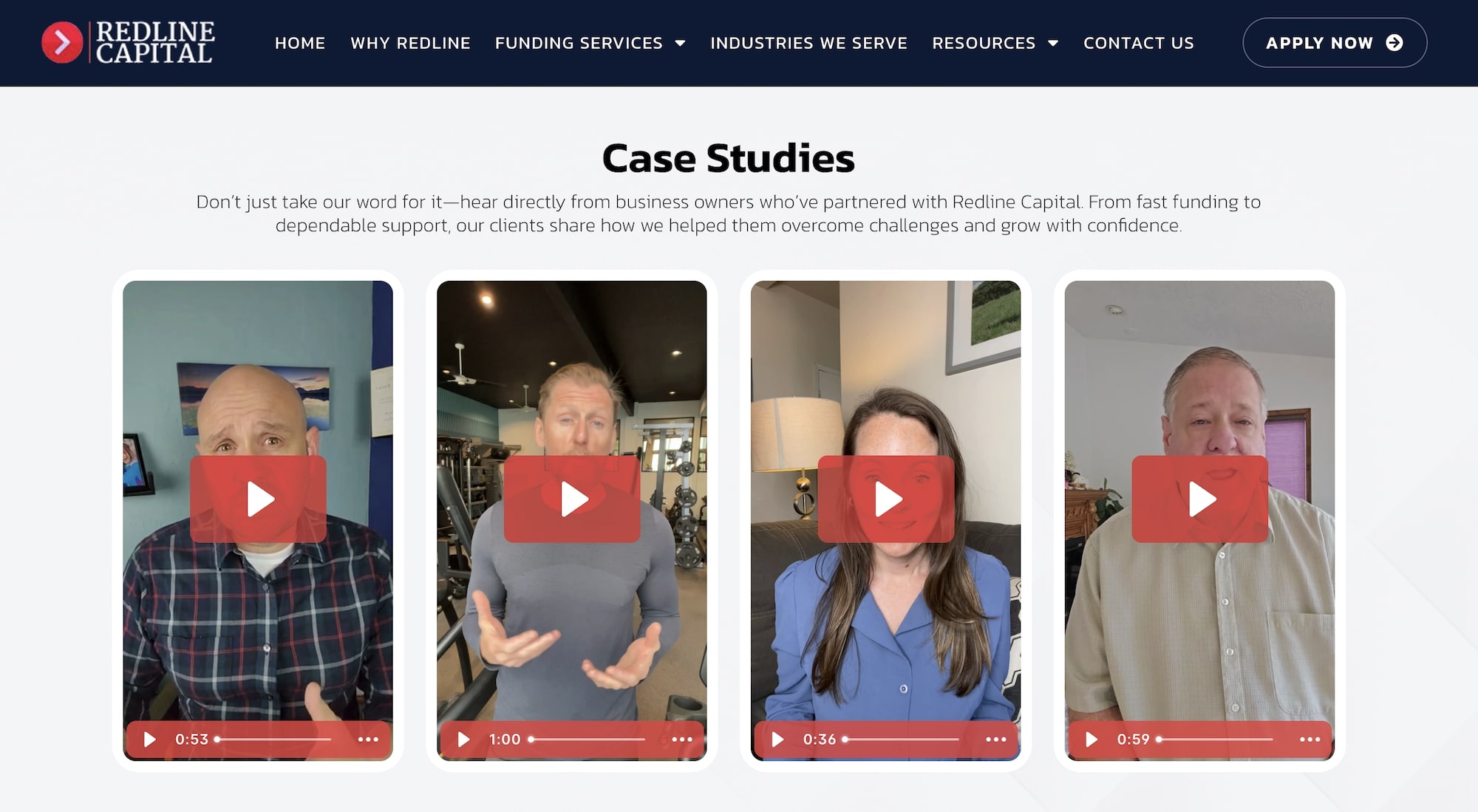
Hear first-hand what businesses say about our offers, closing speed, and low-pressure approach.


You can also watch client testimonials on our fast funding and affordable rates:
Submit 4 months of bank statements to apply for spa financing, and get offers that can fund as early as the same day.
2. Traditional Bank Loans
Traditional bank loans are what most business owners think of first when they need funding. These are standard term loans from banks like Chase, Bank of America, or your local credit union, where you borrow a specific amount and pay it back over a set period with interest.
The appeal is obvious: interest rates typically range from 6% to 15%, which is significantly lower than most alternative financing options. You’ll also get predictable monthly payments and the ability to build a relationship with a financial institution.
But here’s what many business owners don’t realize until they apply: banks have extremely strict requirements. You’ll need excellent credit (usually 720+), comprehensive financial documentation including profit and loss statements, tax returns, balance sheets, and often personal guarantees. The approval process typically takes weeks or months, not days.
Banks are also conservative about lending amounts. They won’t be aggressive based on your receivables or future revenue potential. If you’re generating $100,000 per month in revenue, they might approve you for $50,000 at most based on your credit profile and documented financials.
Traditional bank loans work best for established businesses with strong credit, complete financial records, and time to wait for approval. They’re not a solution when you need to make payroll next week or when your accountant is still working on your P&L statements.
3. SBA 7(a) Loans
Small Business Administration (SBA) loans are government-backed loans designed to help small businesses access capital. The SBA doesn’t lend money directly; instead, it guarantees a portion of the loan, reducing the risk for banks and making them more willing to lend.
SBA loans offer some of the best terms available: interest rates are typically lower than conventional bank loans, repayment periods can extend up to 25 years, and down payment requirements are often reduced. The 7(a) loan program is the most common, covering working capital, equipment, and real estate.
The trade-off is complexity and time. SBA loans require extensive documentation, including a detailed business plan, financial projections, tax returns, and personal financial statements. The approval process can take 60 to 90 days or longer. You’ll also pay SBA guarantee fees, which can add to the overall cost.
These loans make sense for businesses that need larger amounts of capital (typically $50,000 to $5 million), have time to navigate the application process, and meet the SBA’s eligibility requirements. They’re particularly valuable for real estate purchases or major equipment investments where the longer repayment terms justify the paperwork.
4. Invoice Factoring
Invoice factoring involves selling your outstanding invoices to a factoring company at a discount. Instead of waiting 30, 60, or 90 days for customers to pay, you get cash immediately, typically 70% to 90% of the invoice value upfront.
This works well for businesses with creditworthy customers who pay reliably but slowly. Contractors working with government agencies or large corporations are prime candidates because their clients eventually pay, but the payment cycles create cash flow gaps.
The cost varies but typically ranges from 1% to 5% of the invoice value per month until your customer pays. Unlike traditional loans, approval is based primarily on your customers’ creditworthiness, not yours. This makes factoring accessible even for newer businesses or those with credit challenges.
The downside is that factoring companies take over your collections process, which means your customers know you’re factoring. Some business owners worry this makes them appear financially unstable. Also, if you have customers who frequently dispute invoices or pay extremely slowly, factoring becomes expensive quickly.
Factoring works best for B2B businesses with reliable customers, predictable payment cycles, and immediate business needs. It’s particularly valuable when you need to pay for materials and labor upfront while waiting for project payments.
5. Equipment Financing
Equipment financing is designed specifically for purchasing business equipment, vehicles, or machinery. The equipment itself serves as collateral, which makes this type of financing more accessible than unsecured loans.
Interest rates are generally reasonable, between 8% to 30% depending on your credit and the equipment type. Since the lender can repossess the equipment if you default, they’re willing to work with businesses that might not qualify for other types of loans. Repayment terms usually match the equipment’s useful life, often 2 to 7 years.
The main limitation is obvious: you can only use the funds for equipment purchases. You can’t use equipment financing to cover payroll, rent, or other operating expenses. Also, you’re typically required to make a down payment of 10% to 30%.
This loan option makes sense when you need specific equipment to grow your business, and the equipment will generate enough additional revenue to cover the payments. It’s particularly valuable for businesses in manufacturing, construction, healthcare, or transportation where equipment directly impacts revenue generation.
6. Business Credit Cards
Business credit cards offer quick access to revolving credit, often with approval in minutes or hours.
Interest rates are high, typically 15% to 25%, but you only pay interest on outstanding balances. Many cards offer introductory 0% APR periods that can provide short-term financing at no cost if you can pay the balance before the promotional rate expires.
Credit limits are usually lower than what you might get with a term loan, often starting at $5,000 to $25,000 for newer businesses. Your personal credit score heavily influences approval and loan terms, and you’re usually personally liable for the debt.
Business credit cards work well for managing short-term cash flow needs, earning rewards on business purchases, and building credit history. They’re not ideal for large capital investments or long-term financing needs due to high interest rates and lower credit limits.
7. Merchant Cash Advances
Merchant cash advances (MCAs) provide businesses with a lump sum of capital in exchange for a percentage of future revenue. Traditionally, repayment was tied specifically to daily credit card sales, but most modern MCAs are now based on total daily or weekly bank deposits, not just card transactions.
The primary advantage of MCAs is speed and accessibility. Approval is typically based on recent revenue performance rather than personal credit scores, tax returns, or extensive financial statements. Many businesses can receive approval and funding within 24 to 48 hours, making MCAs a common solution for urgent cash flow needs.
MCAs generally use factor rates ranging from 1.18 to 1.49, meaning a $100,000 advance may require repayment of $118,000 to $149,000. Repayments are automatically deducted as a percentage of daily or weekly revenue, causing payment amounts to fluctuate with sales volume.
MCAs are best suited for businesses with consistent revenue streams, such as restaurants, retail stores, e-commerce brands, and service-based businesses that process regular deposits and need fast access to capital without traditional lending requirements.
8. Peer-to-Peer Lending
Peer-to-peer (P2P) lending platforms connect businesses with individual investors willing to lend money. Companies like Funding Circle and Kiva facilitate these transactions, handling the underwriting and loan servicing.
P2P lending often offers more flexible loan terms than traditional banks and faster approval processes. Interest rates typically fall between traditional bank loans and alternative lenders, usually 10% to 30%.
Loan amounts are generally smaller than what you might get from a bank, typically ranging from $25,000 to $500,000. You’ll still need decent credit and financial documentation, though requirements are often less stringent than traditional banks.
P2P lending works well for businesses that don’t qualify for traditional bank loans but want better terms than alternative lenders offer.
9. Asset-Based Lending
Asset-based lending allows you to borrow against your business assets, inventory, equipment, real estate, or accounts receivable. The lender evaluates your assets and provides a loan based on a percentage of their value.
This type of financing can provide access to larger amounts of capital than unsecured loans, often 70% to 90% of asset values. Since assets serve as collateral (e.g., commercial real estate, equipment, bank accounts), approval is less dependent on credit scores and more focused on asset quality and liquidity.
The complexity comes in asset valuation and ongoing monitoring. Lenders typically require regular reporting on asset levels and may conduct periodic audits. Interest rates vary widely based on asset types and business risk, typically ranging from 8% to 20%.
Asset-based lending works best for businesses with substantial physical assets like manufacturers, distributors, or retailers with significant inventory or equipment. It’s particularly valuable when you need larger amounts of capital than unsecured financing can provide.
10. Microloans
Microloans are small business loans, typically under $50,000, offered by non-profit organizations and community lenders. Unlike revenue-based financing, microloans are actual loans with traditional interest rates and fixed monthly payments over multiple years.
However, like traditional bank loans, the main drawback of microloans is extensive documentation requirements, including business plans, financial statements, and personal guarantees. The approval process takes weeks or months, not hours. Most microlenders also require collateral and have strict credit requirements.
Microloans work best for established businesses with solid credit, complete financial records, and time to wait for approval. If you need money today to make payroll or have credit challenges, microloans won’t solve your problem fast enough.
Secure Fast Financing for Your Spa or Wellness Business with Redline Capital
You apply for spa business financing by sending us 4 months of bank statements and we’ll provide offers that could be funded on the same day.