


A revolving line of credit is one of the most flexible financing tools for managing cash flow. You draw only what you need, pay interest on just that amount, and the credit becomes available again once you repay.
However, Chicago banks reject small business loan applications at some of the highest rates in the country. Newer businesses and owners with imperfect credit or thin financial records get turned down regularly, even when they could repay a line of credit.
The challenge is finding a Chicago lender that will extend a line of credit large enough to cover your expenses, without last-minute rejections, weeks of paperwork, or excessive interest rates.
So, before you apply anywhere, here are the questions to ask to guide which lender you choose.
- Can you actually qualify? Many Chicago banks set steep requirements, and you often don’t find out you’ve been rejected until you’re deep into the application process. That wastes time and delays closing because you have to start over with another lender. We recommend applying somewhere realistic from the start.
- How much paperwork does the lender ask for? Many lenders promise fast funding but take much longer to deliver, so a lender’s advertised closing speed is a poor indicator of how fast you’ll actually fund. A better indicator is how much paperwork they ask for, since more documents mean more underwriting time and slower funding.
- What does the line really cost? The advertised rate is only part of the price. Variable rates, draw fees, origination fees, annual fees, and renewal fees all add to what you pay, so compare the APRs of different lenders.
- Will the credit limit cover what you actually need? Some lenders cap small business lines at $5,000 to $25,000, which can fall short of a payroll run or a seasonal inventory order and leave you piecing together several loans and credit cards to cover the rest. Look for a lender willing to extend a higher limit, so one line covers what you need.
We ranked the lenders in this article against these factors, so you can see how each one measures up before you apply.
Use our loan calculator to pull instant quotes and see the rates, terms, and credit limits your business qualifies for.
Redline Capital: Same-day business lines of credit at competitive rates
Redline Capital is a revenue-based financing lender that has helped small businesses across the City of Chicago secure the working capital they need, including those turned away by local banks for not clearing their eligibility bar.
We’ve funded Chicago businesses across the industries that drive the local economy, including:
- Restaurants, bars, and cafes
- Trucking, freight, and logistics operators serving Chicago’s role as a national rail and highway hub
- Construction companies and specialty trades
- Medical, dental, and veterinary practices
- Law firms and professional services
- Printing and light manufacturing
- Salons, barbershops, and spas
- Auto repair shops and HVAC businesses
- Retailers and e-commerce operators
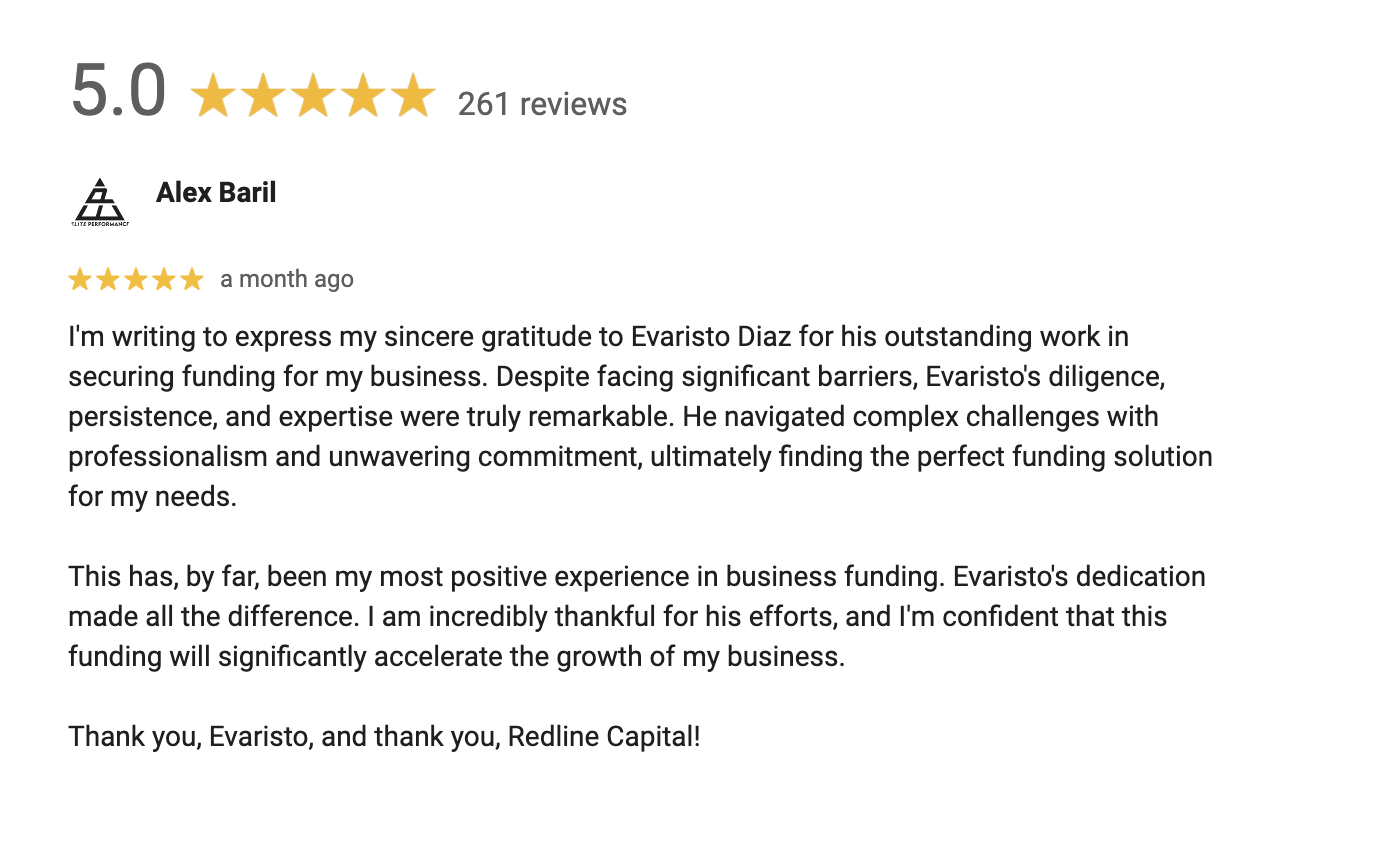
Here’s what borrowers tell us about working with Redline:


Criteria #1: We approve 80%+ of businesses that apply
Our qualification criteria are simple, and revenue carries more weight than anything else.
If your Chicago business brings in $30,000 or more a month and has been operating for at least 12 months, you qualify. We don’t ask for perfect credit, strong profitability, cash reserves, or a personal guarantee on our unsecured lines of credit.
That’s a much lower bar than what Chicago banks require, and the approval numbers reflect it. Only 13% of applicants get approved for business loans at a bank, while we approve more than 80%.
Criteria #2: Four months of bank statements and same-day funding
Fewer requirements mean less paperwork for us to underwrite. There’s no credit history to pore over, collateral to appraise, or years of financials to reconcile.
All we ask for is four months of bank statements so we can verify you meet the $30,000 monthly revenue threshold. That’s enough for us to send you an offer within hours and wire funds to your account the same day you accept.
Criteria #3: Transparent offers with no pressure to sign
We can offer more competitive rates and terms than what you’ll get elsewhere.
That’s because we’re an established broker with strong relationships with top lenders, including OnDeck, Headway Capital, and Rapid Finance. We’ve sent them millions of dollars in qualified business, which has helped grow their lending operations.
In exchange, they offer our applicants better rates and terms than a business would secure by applying to them directly.
Criteria #4: Credit limits up to $750,000 or 200% of monthly revenue
Chicago banks and credit unions are risk-averse lenders, and they often cap small business lines of credit at $5,000 to $25,000, or at a small percentage of your monthly revenue. They size limits that way to protect their own exposure, not to match what your business needs to run.
We take a different approach. Because we underwrite on revenue alone without capping you on credit, collateral, or profit margins, we can extend credit lines up to $750,000 or as much as 200% of your monthly revenue, enough to comfortably cover payroll, inventory, rent, and other recurring expenses.
Find out how much credit your Chicago business can unlock
Enter a few details into our instant loan pricer to preview your limit, rate, and terms, then send four months of bank statements to receive offers as early as the same day.
Alternative Line of Credit Lenders in Chicago
We built our process to fix the problems we see with other Chicago lenders (i.e., slow funding, strict requirements, and expensive rates) so most Chicago businesses find us to be a strong fit.
But it’s always worth comparing options, so we’ve included four alternatives below, ordered by borrower fit rather than lender size.
Byline Bank: Best fit if you suit traditional bank underwriting
Byline Bank is a Chicago-headquartered commercial bank with approximately $9.9 billion in assets and 44 branch locations throughout the Chicago and Milwaukee metro areas. It’s also one of the top lenders of Small Business Administration loans in the country by volume, which gives it real small business expertise most regional banks don’t have.
Its Byline Express program offers revolving lines of credit from $25,000 to $500,000 on a two-year LOC term, with both variable and fixed rate options. For larger needs, Byline offers commercial loans and lines of credit over $500,000 through its business banking group.
To qualify, your business needs to be located in Chicagoland, be for-profit, and have been operating for at least two years. The business also needs to open an operating account with Byline before loan closing.
Applications start by contacting a business banker at a local branch, which means your timeline depends on that banker’s availability and workload rather than an automated online application process. Byline Express is designed to be faster than traditional commercial lending, but it’s still slower than a lender working purely from bank statements.
Allies for Community Business (A4CB): Best fit for early-stage businesses or those turned down by banks
Allies for Community Business is a Chicago-headquartered nonprofit CDFI that has operated on the West Side since 1994. The lender has funded more than $115 million to over 10,000 small business owners, focusing on entrepreneurs across Chicagoland who’ve historically struggled to access capital through traditional banks.
A4CB offers both term loans and lines of credit between $500 and $100,000. The line of credit specifically carries no application fee and no annual fee, and personal collateral isn’t required.
What sets A4CB apart is the underwriting. Most lenders, including Redline, use credit scores at some point in the process (we use them only to price offers, not to approve them). A4CB doesn’t consider credit scores or the value of collateral at all in assessing loan applications, which it cites as a direct response to the barriers its target clients face at traditional banks. For a Chicago business owner who’s been turned down because of a thin credit file or past credit damage, that’s a real alternative.
A few limitations to flag. The $100,000 cap won’t cover payroll or inventory for larger operations. A4CB is focused on Chicagoland and prioritizes businesses in low-to-moderate income neighborhoods, so it isn’t open to every business the way a bank or a national lender is. And because A4CB pairs lending with free coaching and operates as a mission-driven nonprofit, timelines are relationship-driven rather than same-day. That’s a feature if you want the support and a drawback if you need funds this week.
For an early-stage Chicago business, or one that’s been turned away by a traditional bank, A4CB is one of the strongest options on this list.
Credibly: Best fit if you have steady deposits and want a larger online line
Credibly is an online lender that was founded in 2010 as RetailCapital and has offices in New York, Arizona, and Michigan. It sells working capital loans and merchant cash advances alongside its business line of credit, so the line is one product among several.
Its line of credit runs from $5,000 to $300,000, with repayment terms of 3 to 24 months and payments made weekly or monthly. That ceiling is three times A4CB’s $100,000 cap, which makes Credibly a better fit if your payroll or inventory needs outgrow a smaller line.
To qualify, Credibly asks for at least six months in business, $20,000 or more in monthly revenue, and a business bank account. It says its line of credit partners accept applications starting at a 700 credit score, although some reviews list 675, and it weighs consistent monthly deposits heavily in underwriting. The six-month minimum is much shorter than the two years most Chicago banks want, but the credit requirement is steeper than the time-in-business requirement.
Credibly quotes interest as a monthly rate of 3% to 5%, which works out to a much higher annual cost than a bank line, so run the numbers on total repayment before you accept. The credit and revenue requirements are also steeper for the line than for its working capital loans, which makes the line harder to qualify for than its other products. Credibly notes that not every product is available in every state, so confirm that the line is offered in Illinois before you apply.
One thing worth knowing: Credibly is one of Redline Capital’s lending partners. If you’d like to compare Credibly’s offer against the version we can secure, our team can usually run both in parallel.
Wintrust: Best fit for a long-term local banking relationship

Wintrust is one of the biggest small business banks in the Chicago area, operating fifteen community bank subsidiaries with more than 175 banking locations across greater Chicago, southern Wisconsin, and northwest Indiana. Small business clients get paired with a dedicated relationship manager, which helps if you want someone who knows your business finances over the long term.
Wintrust offers two tiers of small business lending. Its Easy Access Line of Credit tops out at $5,000 and is positioned for sole proprietors covering unexpected expenses, inventory, and day-to-day costs. For larger needs, Easy Access loans and lines of credit go up to $250,000, with fully customized lines of credit, term loans, equipment financing, and Small Business Administration loans available beyond that through its general business lending team.
The strength of Wintrust is the breadth. Whether you need $5,000 to cover a slow month or several million for a growth round, there’s a product for it, along with merchant services and business credit cards. The friction is that eligibility isn’t published in advance for the larger products, so you need to start a conversation with a banker to find out whether you qualify. That relationship-driven process works for businesses that want a long-term partner but tends to move slower than an online application built for speed.
BMO: Best fit if you want full-service banking consolidation

BMO has a long Chicago presence, with its U.S. headquarters based downtown and a strong branch network across the metro area. It offers business lines of credit alongside term loans, equipment financing, commercial mortgages, and SBA financing, as well as cash management services, which makes it a reasonable one-stop option for businesses that want to consolidate their banking.
BMO offers two tiers of small business lines of credit. Standard lines cap total bank credit exposure at $50,000. Committed lines run from $100,000 to $1,000,000, with unsecured lines of credit available if your total borrower commitment is $100,000 or less.
Three conditions stand out. Business applicants approved for any line of credit must open a BMO business checking account before loan closing, which can mean switching your primary banking relationship. Committed lines of $100,000 to $1,000,000 require you to maintain a 12-month average BMO balance of at least $250,000, which effectively means parking a quarter-million dollars in deposits to borrow six figures. And the application process goes through a full business banker review of your business finances, including tax returns, financial statements, and ownership documentation, which rules out same-day funding.
Frequently Asked Questions
I’ve been turned down by a Chicago bank. Does that mean I can’t get a line of credit?
No. Bank rejection in Chicago is common, especially for newer businesses, businesses in historically underbanked neighborhoods, and owners with thin or imperfect credit files. Revenue-based lenders like Redline Capital underwrite on monthly revenue rather than credit, time in business, or location. CDFIs like Allies for Community Business don’t look at credit scores at all. A bank “no” closes one door, not the whole house.
What credit score do I need for a business line of credit in Chicago?
It depends on the lender. Chicago banks typically want strong personal credit, often a FICO of 680 or higher, though specific thresholds vary by lender and loan size. Online lenders like Credibly generally look for a score around 700 for a line of credit. Revenue-based lenders like Redline Capital don’t set a credit floor at all, and A4CB doesn’t consider credit scores. If your credit is a question mark, start with a lender whose underwriting doesn’t lead with it.
Can a newer Chicago business qualify for a line of credit?
Yes, but your options narrow. Most Chicago banks require two or more years in business, so a business that’s younger than that is usually ruled out at a bank. Redline Capital requires 12 months in business, Credibly requires six months, and A4CB works with early-stage businesses on a different model entirely.
Do Chicago banks require me to open a business checking account?
Several of them do. Byline Bank requires applicants to hold an operating account with them before loan closing, and BMO requires a business checking account for line of credit approval. BMO’s committed lines of credit go further and require you to maintain a 12-month average balance of at least $250,000. If you’d rather keep your existing banking relationship, lenders like Redline Capital and Credibly don’t ask you to open a new account with them.
How fast can I get a business line of credit in Chicago?
That depends almost entirely on paperwork. A revenue-based lender working from four months of bank statements can send offers within hours and fund the same day. A Chicago bank doing traditional commercial lending, which asks for tax returns, financial statements, and a UCC filing, is more likely to take one to three weeks from application to funding, sometimes longer if the request routes through SBA processes.
What is a CDFI, and should I apply to one?
A CDFI (Community Development Financial Institution) is a certified mission-driven lender that focuses on borrowers traditional banks underserve, often in low-income or minority neighborhoods. In Chicago, the most prominent small business CDFI is Allies for Community Business. CDFIs typically offer smaller loan amounts, move at a slower, more relationship-based pace than a bank or online lender, and often pair lending with coaching and business planning help. They’re a strong fit for early-stage businesses, borrowers with imperfect credit, or those who’ve been turned down elsewhere.
How are business line of credit rates calculated?
Banks typically price lines of credit at a variable rate tied to the prime rate (for example, prime + 2% to prime + 11%), with your actual spread based on credit, revenue, and collateral. Online lenders and revenue-based lenders usually quote an APR or a factor rate that accounts for interest, draw fees, and term length in one number, which makes comparing offers across lenders easier. Always ask for APR before signing.
Does applying for a line of credit hurt my credit score?
It depends on how the lender checks your credit. Most Chicago banks run a hard credit pull during the application, which temporarily lowers your score by a few points. Redline Capital runs a soft pull, which doesn’t affect your score at all, and A4CB doesn’t check credit. If you’re planning to shop multiple lenders, start with the ones that use soft pulls so your options don’t shrink as you go.