


It’s common for insurance agencies to use a line of credit for working capital while they wait for commissions from insurance carriers to come in. They can draw what they need, pay interest only on that amount, and when they repay it, it becomes available again.
But despite the benefits of a line of credit, the lender you choose matters because it affects how easy it is to qualify, how fast you get funded, and what you pay in interest and fees.
To help insurance agencies get a line of credit quickly and at a low rate, we wrote this guide on what to look for in a lender and how popular lenders compare.
Find out what your insurance agency qualifies for (rates, terms, limits) in minutes with our instant loan pricer. When you’re ready, submit four months of bank statements, and you’ll have the option to close as quickly as the same day or the next.
| Lender | Minimum credit score | Time in business | Funding speed | Max line | Insurance agency focus |
| Redline Capital | None | 12 months | Same day or the next | $750,000, or 200% of monthly revenue | Several years and hundreds of millions in lines of credit |
| Bluevine | 625 | 12 months | Decision in as little as 5 minutes, funds in hours to the next business day | $250,000 | Publishes an insurance agency guide |
| Loot | None | 1 year | Same business day possible | $100,000 | Publishes an insurance agency page |
| OnDeck | 625 | 1 year | Repeat draws can be instant | $100,000 | General lender (700+ industries) |
| Rapid Finance | 550+ (reported) | 24 months | Same day to 3 business days | About $250,000 | General lender |
Factors to Consider When Choosing a Line of Credit for Your Insurance Agency
What are the lender’s requirements?
Many line of credit lenders have extremely high, sometimes unrealistic requirements, asking for near-perfect personal credit, several years in business, personal guarantees, healthy cash flow, low debt-to-income ratios, and more. Due to this, only about 13% of businesses that apply at banks get approved.
What’s worse, businesses typically don’t learn they’ve been rejected until weeks into the application, and by then they’ve lost time they could have spent applying elsewhere.
So check a lender’s criteria before you commit. One with more realistic requirements gives you a fair shot at qualifying from the start.
How much paperwork does the lender require?
Many lenders promise fast funding on their homepage, but from what we hear from borrowers, few can actually deliver. Lenders will promise to close in a day or two, and when you fast forward a few weeks later, the money still hasn’t arrived in your account.
If speed matters to you, we recommend not taking a lender’s advertising claims at face value. Check how much paperwork they ask for, since that’s a better indication of how quickly they’ll actually fund.
Every document you have to submit is something the lender has to evaluate and underwrite. The longer the list, the longer you can expect to wait for your funds.
Does the lender pressure you to sign?
Pressure is one of the clearest signs of a bad offer. A lender with a good rate doesn’t need to hurry you, because it knows the numbers hold up next to anyone else’s.
Lenders with expensive, sometimes predatory offers often pressure you to sign right away, before you have a chance to see what other lenders would offer. Some even use false urgency, such as claiming another business wants the funds or that the offer expires tonight.
The less pressure a lender puts on you to accept, the more likely the offer is a competitive one.
Does the lender have experience working with insurance agencies?
Lenders who don’t know the insurance industry can mistake normal agency patterns for warning signs.
It’s normal for commissions to arrive in lumps from carriers, for chargebacks to show up as money going back out, and for most of an agency’s revenue to come from just a few carriers.
Yet, an underwriter unfamiliar with this can read it as unstable income, losses, or concentration risk, which can lead to a higher rate or an outright rejection.
Go with a lender that has worked with insurance agencies. They understand how agency finances work and won’t penalize you for it.
10 Line of Credit Lenders Compared to the Factors Above
1. Redline Capital: Same-day Lines of Credit Approved Based on Your Agency’s Revenue
We built Redline because we saw how big banks work. They were slow, buried in paperwork and bureaucracy, and set requirements so strict that most businesses couldn’t qualify.
At Redline Capital, our aim is to make business financing faster and more accessible. Over several years, we’ve helped countless insurance agencies (that banks turned away) secure lines of credit, totaling hundreds of millions of dollars.
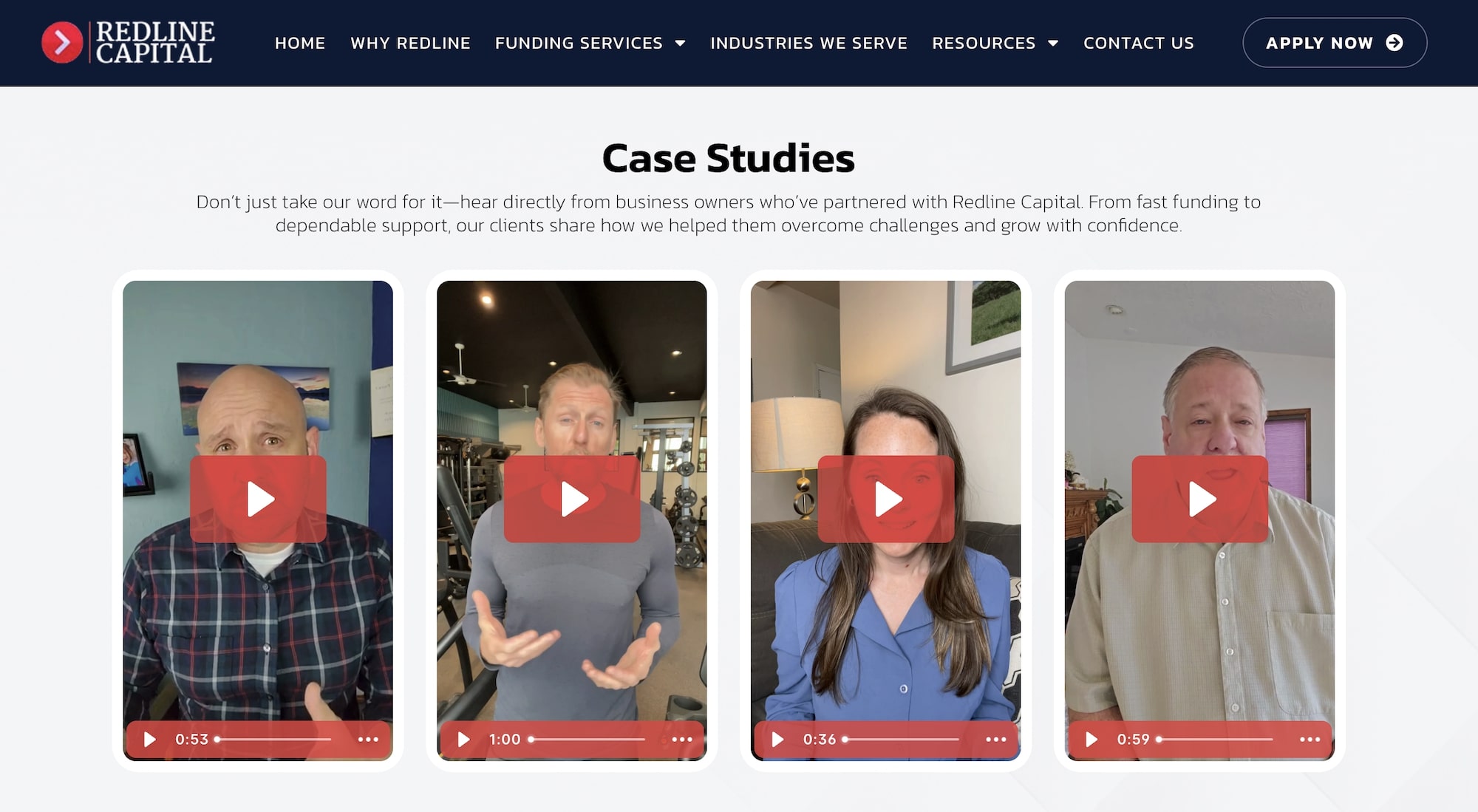
Hear directly from our borrowers.


Visit our case studies page to watch borrowers talk about their experience with Redline Capital:
We Only Have Three Requirements and Approve Over 80% of Businesses
We designed our requirements for businesses that banks and other financial institutions turn away. Instead of judging your credit history and entire financial profile, we check that your agency brings in enough revenue and has been operating long enough.
To qualify, you need:
- $30,000 or more in monthly revenue
- At least 12 months in operation
- A U.S.-based business
We don’t ask for a strong credit history, a minimum profit margin, or collateral.
Because our requirements are so accessible, more than 80% of the businesses that apply with us get approved.
Four Months of Bank Statements Is All We Need and We Can Close the Same Day or the Next
As we mentioned earlier, a good way to judge how fast a lender will really move is to look at how many documents it asks you to submit.
At Redline Capital, we deliberately keep our paperwork requirements minimal.
To confirm that your agency brings in $30,000 or more each month, we ask for four months of bank statements. That’s all. We don’t need tax returns, financial statements, business plans, or collateral.
As a result, we can close most lines of credit the same day you apply or the next.
We Never Pressure You Into Accepting Because We Offer Competitive Rates
We don’t push anyone to sign, because we’re confident our offers are strong enough on their own, and most borrowers who look at other options end up coming back to us.
That’s because, for more than a decade, we’ve worked as a broker with top lenders (e.g., OnDeck, Rapid Finance, Headway Capital), and the borrowers we’ve sent them have helped grow their lending businesses.
In exchange, those lenders give us better rates and terms than they offer to businesses that approach them directly, and we pass those terms on to you, which is how we’re able to offer industry-leading rates.
We Know Insurance Agencies, So We Won’t Penalize You for What’s Normal in Your Industry
We’ve worked with insurance agencies for several years, so we know the challenges agencies face across the industry.
This means we don’t mistake normal industry patterns for red flags, so your application is far less likely to be rejected or to come back with an excessive interest rate.
You Can Use Our Lines of Credit for Whatever Your Agency Needs
Our lines of credit aren’t tied to a specific purpose, so you can use them for anything your agency needs. Some common examples include:
- Payroll for producers and staff
- E&O insurance premiums
- Rent and office expenses
- Marketing and lead generation to grow your book of business
- Hiring and onboarding new producers
- Agency management software
- Licensing and continuing education fees
- Covering the gap while commissions come in
- And more
Read more: How to Use a Business Line of Credit: Smart Uses & Mistakes
2. Bluevine

Bluevine is an online lender that says it has delivered more than $16 billion in working capital to over 900,000 U.S. businesses. Its line of credit goes up to $250,000, and a decision can come back in as little as five minutes.
Each draw has its own repayment timeline, and Bluevine reports your repayment history to Experian. That can help an agency build business credit over time.
To qualify, Bluevine generally asks for a personal credit score of 625 or higher, at least 12 months in business, and $10,000 or more in monthly revenue. A single application also checks you for loan offers from its partner lenders.
Repayment terms run 6 to 12 months, which makes each payment larger than it would be on a longer schedule. Bluevine also requires a personal guarantee, and the effective APR can run well above the headline rate once fees and the repayment structure are included.
3. Loot
Founded in Boston in 2021, Loot is a direct lender that funds a revolving line of credit. Its insurance agency financing page is written for independent insurance agents and covers agencies of every type of insurance, including multi-line, property, health, and life insurance.
The loan process is short. The application takes about five minutes online and requires no document uploads. Loot works by linking your business bank account, and funds from an approved draw can reach you as soon as the same business day.
Loot asks for at least one year in business and $200,000 in annual revenue, with no minimum credit score. It uses only soft credit inquiries, so applying doesn’t affect your personal credit.
That $200,000 revenue minimum leaves out smaller agencies, and the $100,000 limit can fall short for an agency with bigger needs. Because Loot funds only a line of credit, there is also no term loan or acquisition product if your plans change.
4. OnDeck

OnDeck began lending to small businesses in 2007 and has delivered more than $15 billion. Its line of credit runs from $6,000 to $100,000, repeat draws can arrive instantly through a debit card, and it carries no draw fees or maintenance fees.
To qualify, an agency needs at least one year in business, a personal credit score of 625 or higher, and $100,000 in annual revenue.
OnDeck also lends to more than 700 industries and doesn’t list insurance agencies as restricted, though it does not lend in Nevada, North Dakota, or South Dakota.
The line has a 12-month repayment term, and OnDeck’s own disclosures show APRs well into the double digits, so compare the true cost before you accept. Because OnDeck lends directly, you get one lender’s view of your agency instead of offers from several.
OnDeck is one of the lenders in Redline Capital’s network. Applying through us may get your agency a better rate than applying directly, because of the volume of business we’ve sent OnDeck over the years.
5. American Express Business Line of Credit

American Express offers business lines of credit, business cards, and checking accounts on one dashboard. The line goes up to $250,000, and each draw becomes its own installment loan repaid over 6, 12, 18, or 24 months.
Eligible applicants can get a decision within minutes when their business data and bank account can be verified automatically. To qualify, American Express asks for a credit score of at least 660 and at least 12 months in business. The required score can be higher depending on your relationship with the company and your credit history.
American Express also states that not every industry is eligible for the line, so confirm that insurance agencies qualify before you apply.
That 660 floor is higher than the minimums at Loot, OnDeck, Bluevine, or Rapid Finance. Reviews also note that Amex weighs credit history and business stability more than revenue, so a newer agency, or one with fair credit, may struggle even with steady commissions.
6. Rapid Finance

Based in Bethesda, Maryland, Rapid Finance has lent to U.S. businesses since 2005 and carries a line of credit alongside term loans, SBA loans, and merchant cash advances. Its line of credit goes up to about $250,000, and funding on most products takes anywhere from the same day to three business days.
For its line of credit, NerdWallet reports a minimum of 24 months in business and $150,000 in annual revenue, along with automatic repayments from a business bank account. Some reviews list minimum credit scores as low as 550.
That two-year minimum rules out newer agencies, and the automatic repayments take a set amount from your account on a fixed schedule, which can strain cash flow in a slow commission month. Rapid Finance also uses a hard credit pull, so checking your options leaves a mark on your credit report.
Rapid Finance works with Redline Capital as a lending partner. Applying through us may get your agency better pricing than applying directly, based on the volume of business we’ve sent them over the years.
7. Credibly
Credibly was founded in 2010 as RetailCapital and now operates as both a lender and a lending network, with offices in New York, Arizona, and Michigan.
Its line of credit goes up to $600,000, comes as a secured or unsecured product, and can be repaid through weekly or monthly loan payments, with approval possible in as little as two hours.
To qualify, Credibly generally asks for a personal credit score of at least 675 and $20,000 in monthly revenue. Credibly uses soft credit checks so checking your options doesn’t affect your credit score.
That 675 credit score minimum is higher than the minimums at most lenders in this comparison, so agencies with fair credit may not qualify. Credibly also doesn’t finance startups, so a newer agency without an operating history may not qualify either.
8. Kapitus

Kapitus, founded in 2006 as Strategic Funding Source, is a direct lender that sells a line of credit alongside a broader range of financing options, including term loans, equipment financing, and invoice factoring.
Decisions can come back in about four hours, funds can arrive as soon as the next day, and its KapitusPLUS process can bring back offers from several lending partners side by side.
Kapitus generally asks for a credit score of at least 650, two years in business, and about $250,000 in annual revenue for its line of credit. Its first check uses a soft credit pull, so comparing offers doesn’t affect your score.
An agency that clears two of the three thresholds still won’t qualify, so newer or smaller agencies with steady commissions are usually left out. Larger agencies with stronger credit are a better fit.
9. FIGFCU (Farmers Insurance Federal Credit Union)

Farmers Insurance Federal Credit Union, known as FIGFCU, is a member-owned financial institution built around employees and agents of the Farmers insurance company.
Its Agent Financing Program includes a line of credit up to $50,000, and a separate Farmers Secured Line of Credit goes up to $100,000 for agents with established contract value. The credit union also issues credit cards and runs a Preferred Agent Mortgage program alongside its insurance agency loans.
FIGFCU also finances agency purchases. Its Agency Acquisition Loan helps Farmers, Allstate, and independent insurance agents buy a book of business, meaning the policies, renewals, and commissions an agency has built, and it also covers refinancing of higher-cost acquisition debt.
However, in order to qualify, a membership is required, and it centers on Farmers employees and agents and their relatives. While a loan is outstanding, Farmers agents must also route their commissions and other payments from the insurance company through a FIGFCU checking account.
FIGFCU designed its Agent Financing lines specifically for Farmers agents, so most independent agencies can’t use them. The secured line of credit also carries a $250 non-refundable application fee and a closing fee of 1% of the loan amount, up to $2,500.
10. Live Oak Bank
Live Oak Bank, a North Carolina-chartered bank founded in 2008, ranks as the country’s top SBA lender by 7(a) volume for fiscal year 2023. Its insurance banking team says it has lent more than $500 million to independent insurance agents and agencies.
The bank’s financing options for agencies include SBA and conventional loans for acquisition, expansion, partner buyout, perpetuation, real estate, and refinancing, and its insurance agency loans start at $10,000. The loan amount runs from $10,000 on Express loans to $5 million on SBA 7(a) loans and $25 million on conventional loans, and an expedited loan process covers requests under $500,000.
Qualifying depends on the product, and SBA 7(a) loans follow SBA eligibility rules. SBA loans carry no covenants, while conventional loans do.
Live Oak structures its insurance agency financing as term loans aimed at buying an agency or a book of business, not at covering the gap between commissions and payroll, so they don’t replace a line of credit. They also come with a fixed repayment schedule, which means the same payment is due each month whether or not commissions arrive on time.